Working documents

Evidence Review: Investments and Policies in Agrifood Chain Linkages

Agrifood systems extend beyond the farm, yet the midstream and downstream—the “hidden middle”—remain under-researched. This paper reviews 276 studies on policies for the hidden middle in low- and middle-income countries. While 52% focus on smallholders and 21% on public goods, only 27% address the hidden middle.

The hidden middle of agrifood systems: a systematic review of leading authors and policy recommendations

This report synthesizes the literature on the Hidden Middle of agrifood systems—the midstream segment that connects producers to markets through processing, logistics, and intermediation. Based on the work of seventeen leading authors and the analysis of 3,500 policy recommendations from 568 publications, it identifies common priorities and canonical policy orientations. 

Welfare and Opportunities for Small-Scale Producers and MSMEs in Rural Africa: An Econometric Analysis

This study examines how participation in commercial agriculture and micro, small, and medium enterprises (MSMEs) is associated with inclusive development outcomes for small-scale producers (SSPs) across six African countries representing diverse income levels.

Social Learning and Peer Influence in Smallholder Commercialization

This paper examines how peer behavior influences small-scale producers’ (SSPs) decisions to purchase inputs and sell outputs in six sub-Saharan African countries. Using comparable nationally representative panel data and a correlated random effects framework, we assess the extent and shape of social interactions driving input and output market participation. 

Does Commercial Small-Scale Aquaculture Drive Inclusive Agricultural Transformation in Odisha?

This report examines whether commercial small-scale aquaculture contributes to inclusive agricultural transformation in Odisha, India, using mixed methods evidence from market, farm, community, and geospatial surveys, and qualitative “rapid reconnaissance” interviews with 41 value chain actors. 

High Value Crop Commercialization and Women’s Empowerment in Sub-Saharan Africa: Panel Insights Reinforced by Double Machine Learning and Quasi-Experiments

We examine how agricultural commercialization relates to women’s empowerment across Ethiopia, Malawi, Tanzania, Uganda, and Nigeria using LSMS-ISA household panels (2010–2020), a modified A-WEAI (5DE), two-way fixed effects, Double Machine Learning, and propensity-score matched difference-in-differences. 

Transformation of the Aquaculture Value Chain in Kenya

The Kenyan aquaculture sector has undergone a profound structural transformation over the last decade, evolving from a subsistence-based activity into a sophisticated commercial ecosystem. This growth is most evident in the cage-based segment of Lake Victoria, which saw an explosive 1,300-fold increase in production volume between 2014 and 2024. 

Farm Productivity and Commercial Agriculture: Evidence from a Stochastic Frontier Analysis in Six Sub-Saharan African Countries

This paper examines whether farm-level commercialization and local intermediary density are associated with improvements in technical efficiency—that is, the extent to which producers operate close to their production frontier given available inputs. 

Farm Transformation of the Tomato Value Chain in Kenya

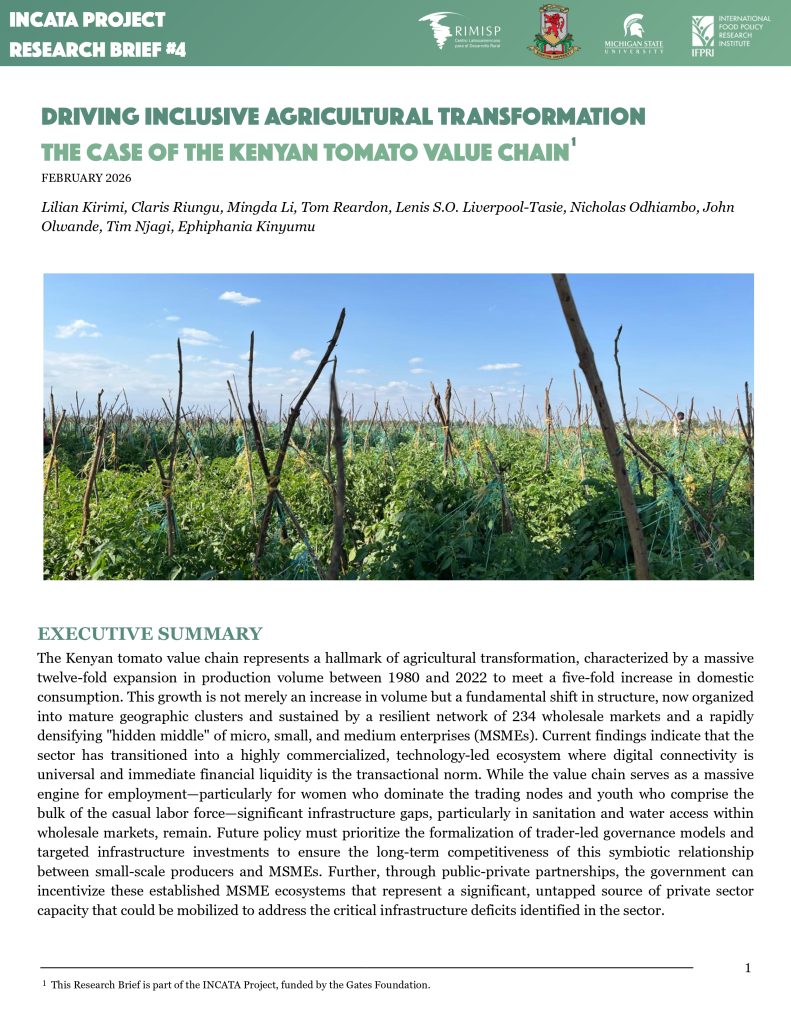
The Kenyan tomato value chain represents a hallmark of agricultural transformation, characterized by a massive twelve-fold expansion in production volume between 1980 and 2022 to meet a five-fold increase in domestic consumption. 

Commercial small scale vegetable producers and inclusive agricultural transformation in Odisha

This report compiles findings from a research project titled “Tracking commercial small-scale producers for inclusive agricultural transformation” (INCATA), that studied the relationships between commercial small-scale producers (farmers) and micro, small, and medium enterprises (MSMEs) in vegetable value chains in Odisha, India. 

Symbiosis Between Commercial Small-Scale Producers and Micro, Small and Medium Enterprises in the “Hidden Middle”: Evidence from the Horticulture Value Chains in Africa and Asia

This report synthesizes evidence from the INCATA project (Linked Farms and Enterprises for Inclusive Agricultural Transformation in Africa and Asia). It finds that small-scale producers are highly commercial and often embedded in mutually beneficial relationships with micro, small, and medium enterprises (MSMEs) in the “hidden middle” of input supply, trading, logistics, and related services. 

Reports to The Gates Foundation

Inception Workshop Report

LSMS-ISA Analyses progress report

Odisha, India & Kenya: Rapid Reconnaissance Value Chain Progress Report

Complete Report: LSMS-ISA Analyses


Project Policy Briefs

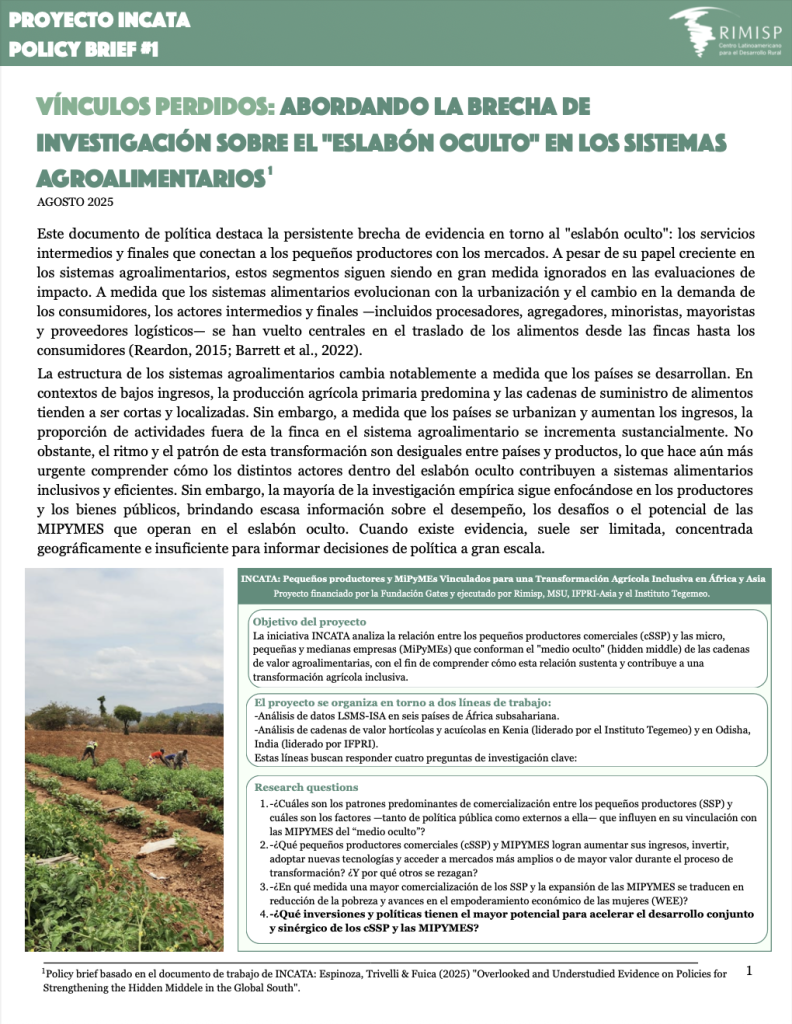
Policy Brief N°1 🇬🇧

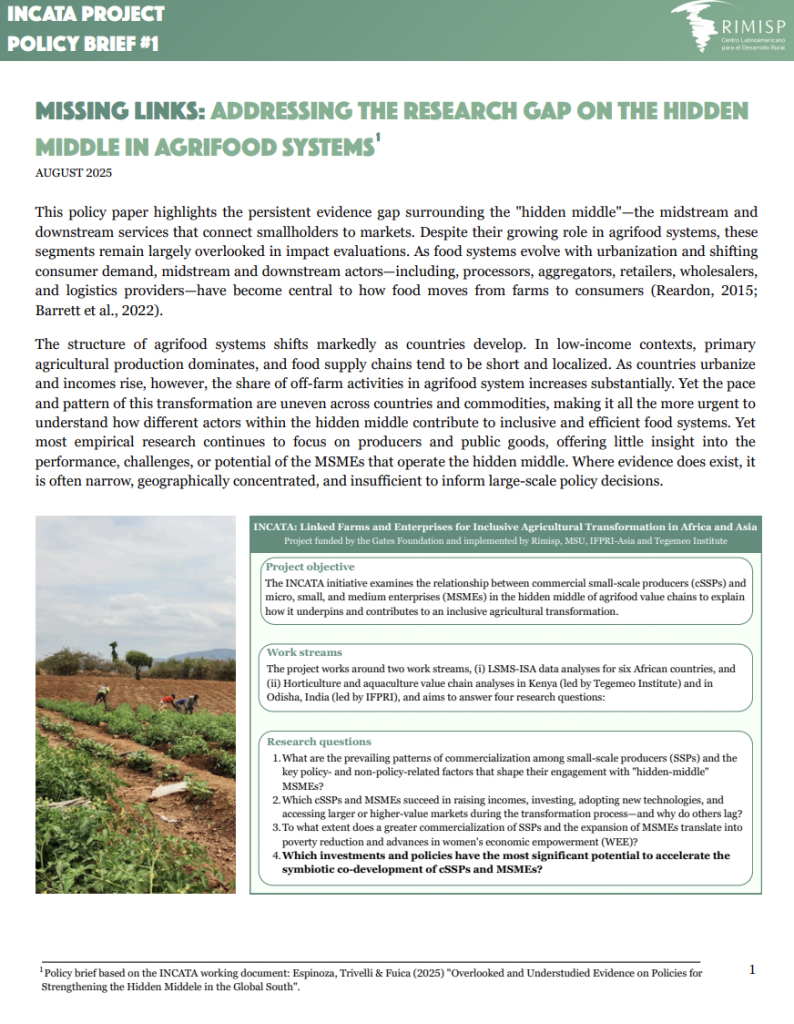
Missing Links: Addressing the Research Gap on the Hidden Middle in Agrifood Systems

 
Policy Brief N°1 🇪🇸
 
Vínculos perdidos: Abordando la brecha de investigación sobre el “eslabón oculto” en los sistemas agroalimentarios
 

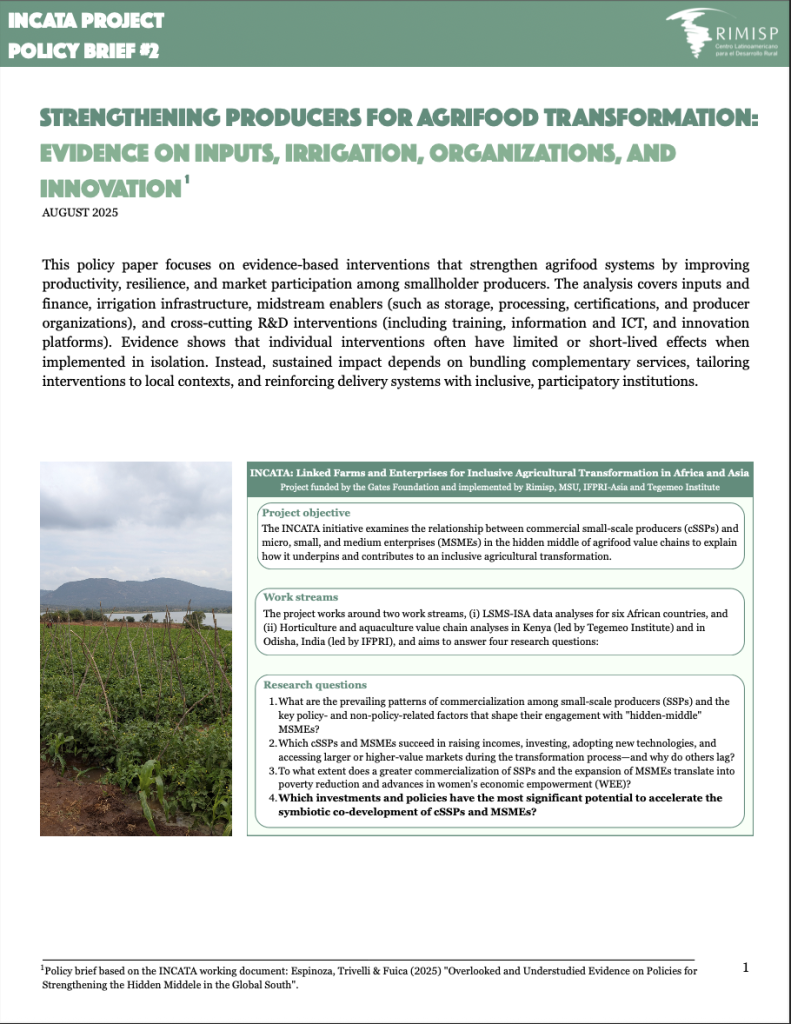
Policy Brief N°2 🇬🇧

Strengthening Producers for Agrifood Transformation: Evidence on Inputs, Irrigation, Organizations, and Innovation 


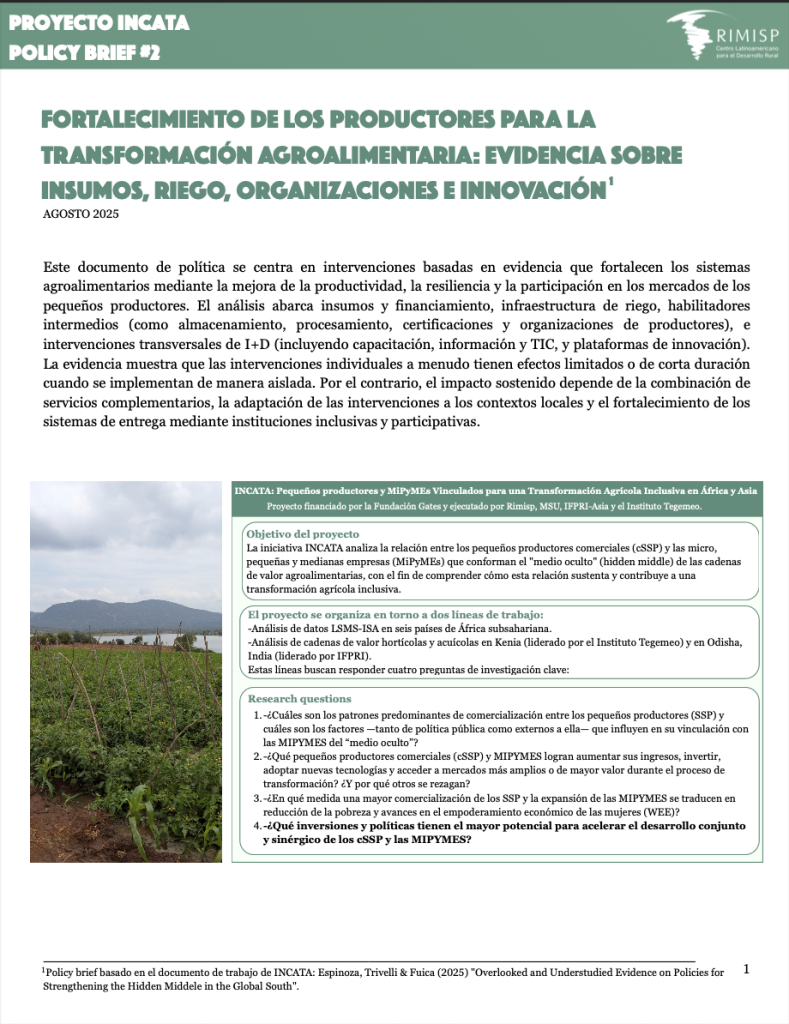
Policy Brief N°2 🇪🇸

Fortalecimiento de los Productores para la Transformación Agroalimentaria: Evidencia sobre Insumos, Riego, Organizaciones e Innovación


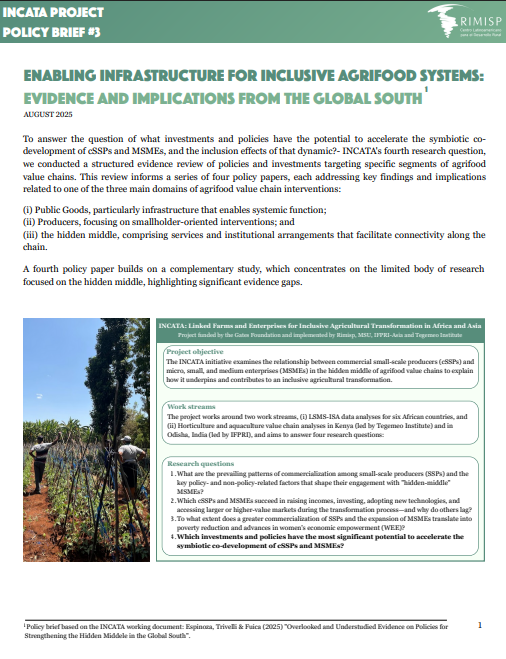
Policy Brief N°3 🇬🇧

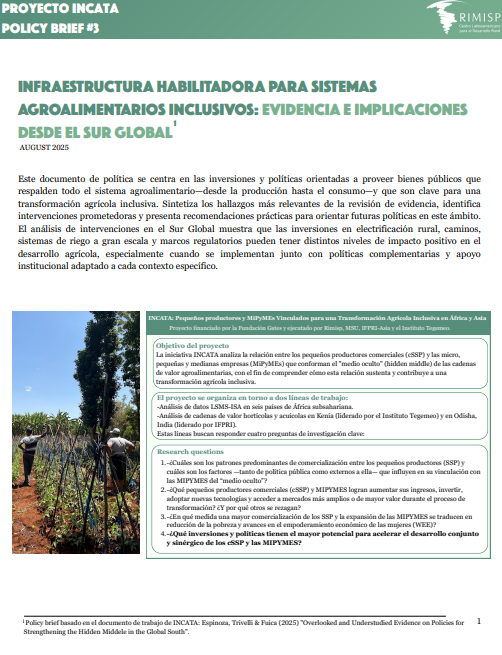
Enabling Infrastructure for Inclusive Agrifood Systems: Evidence and Implications from the Global South


Policy Brief N°3 🇪🇸

Infraestructura habilitadora para sistemas agroalimentarios inclusivos: Evidencia e implicaciones desde el Sur Global


Policy Brief N°4 🇬🇧

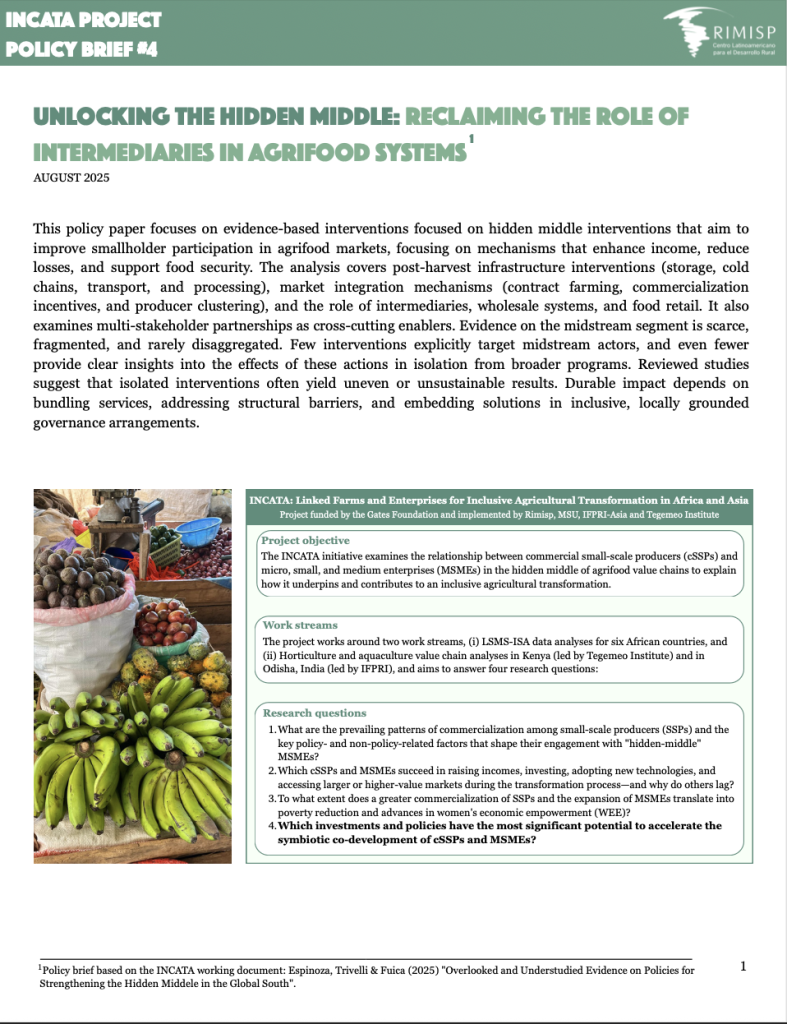
Unlocking the Hidden Middle: Reclaiming the Role of Intermediaries in Agrifood Systems


Policy Brief N°4 🇪🇸

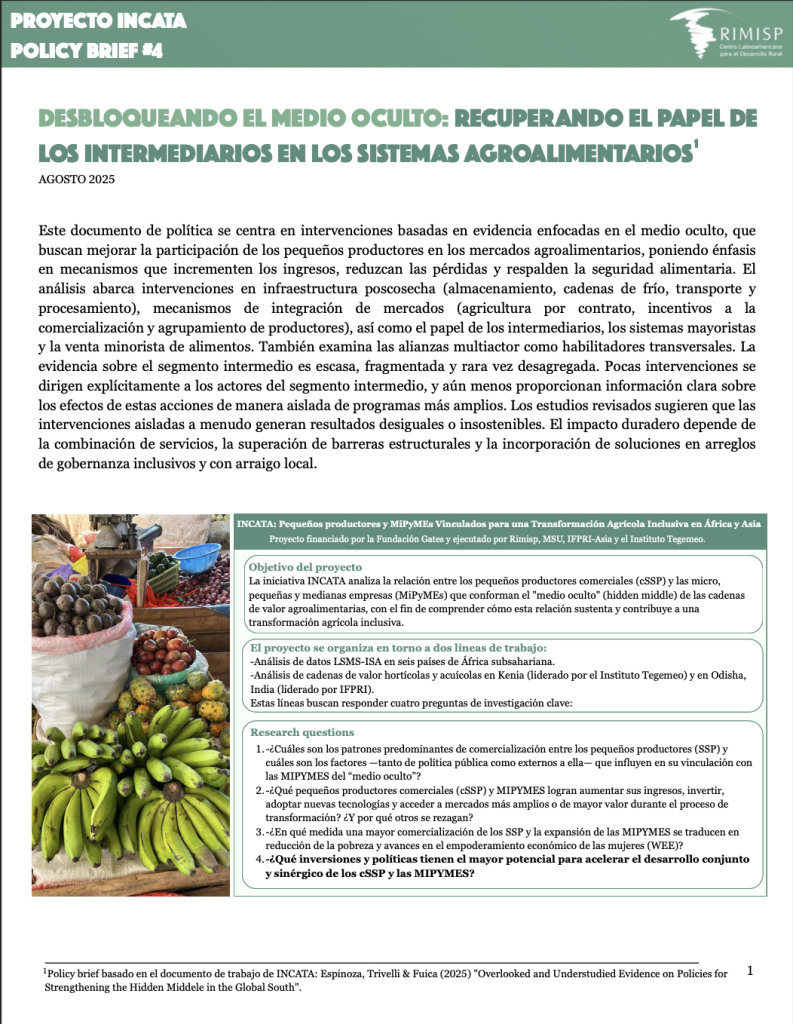
Desbloqueando el Medio Oculto: Recuperando el Papel de los Intermediarios en los Sistemas Agroalimentarios


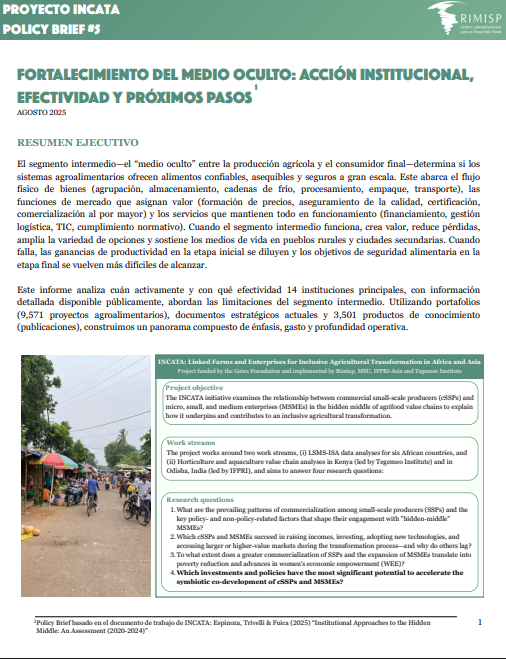
Policy Brief N°5 🇬🇧

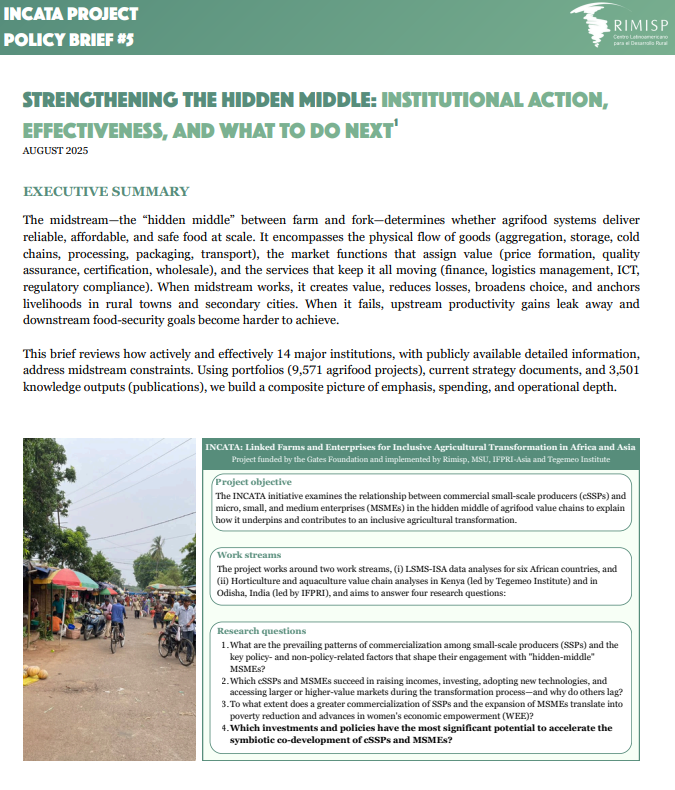
Strengthening the Hidden Middle: Institutional Action, Effectiveness, and What to Do Next


Policy Brief N°5 🇪🇸

Fortalecimiento del Medio Oculto: Acción Institucional, Efectividad y Próximos Pasos


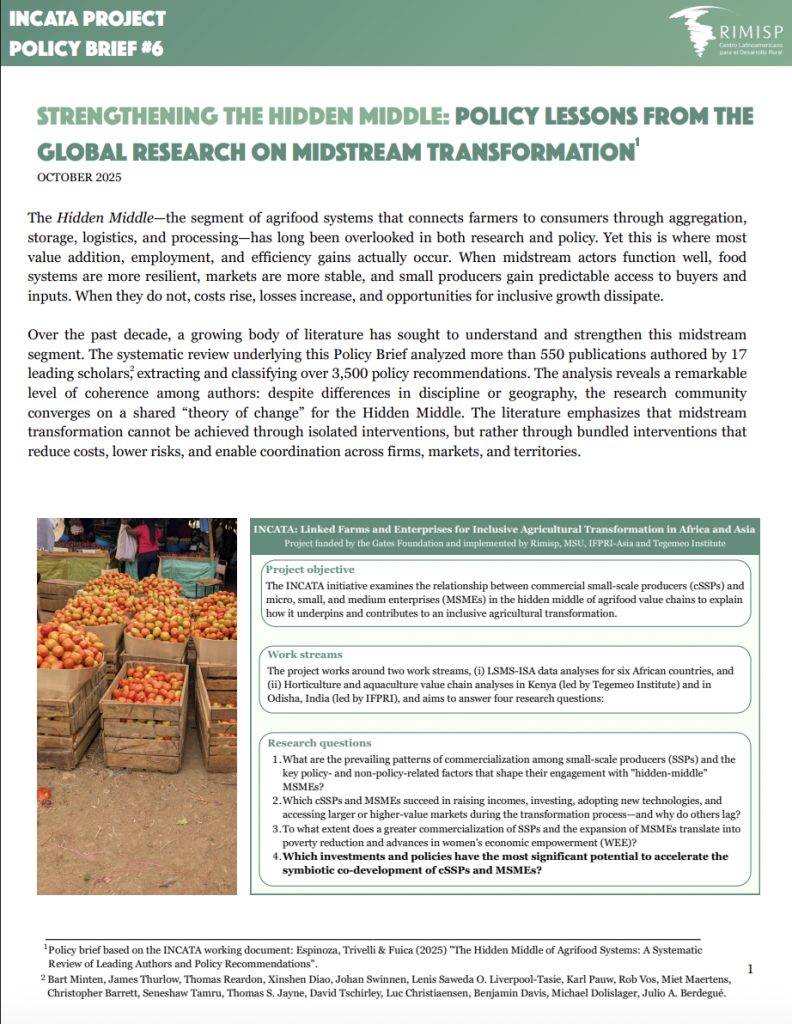
Policy Brief N°6 🇬🇧

Strengthening the Hidden Middle: Policy Lessons from the Global Research on Midstream Transformation


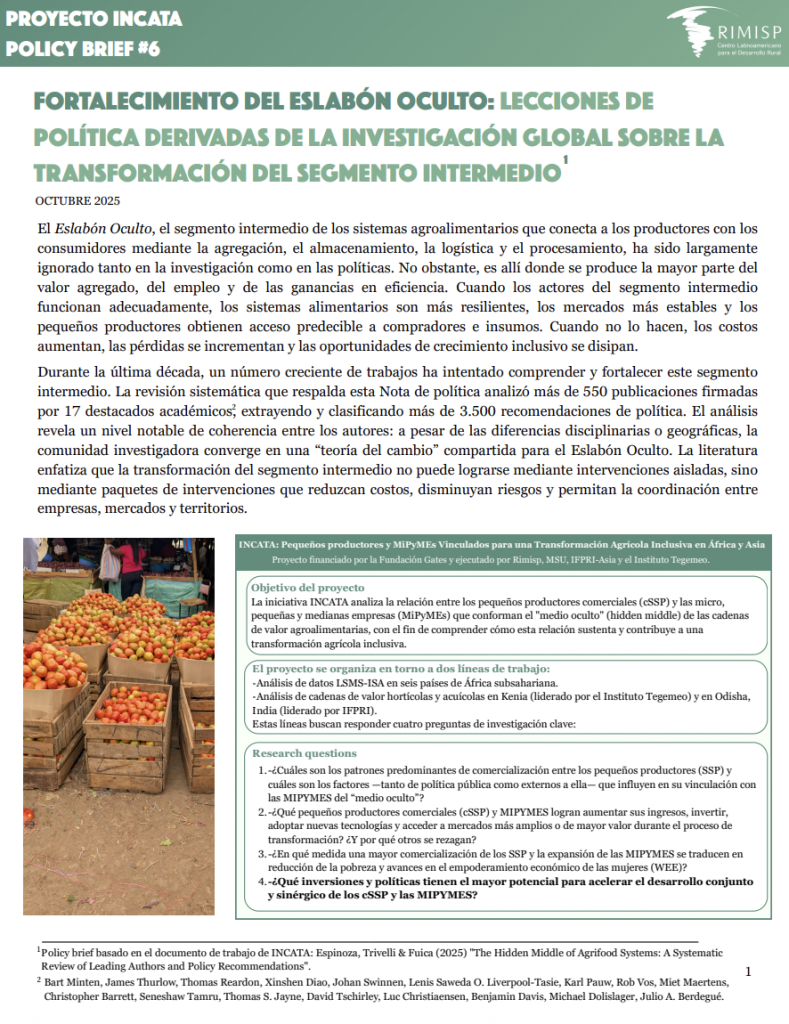
Policy Brief N°6 🇪🇸

Fortalecimiento del Eslabón Oculto: Lecciones de política derivadas de la investigación global sobre la transformación del segmento intermedio


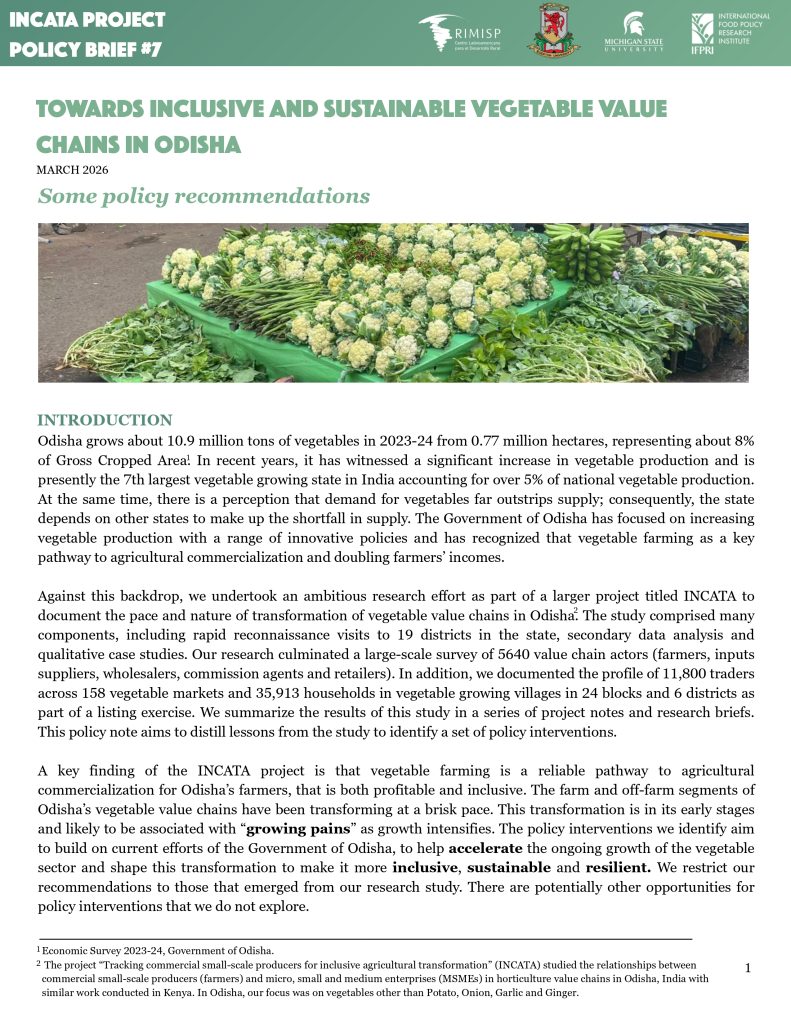
Policy Brief N°7 🇬🇧

Towards inclusive and sustainable vegetable value chains in Odisha


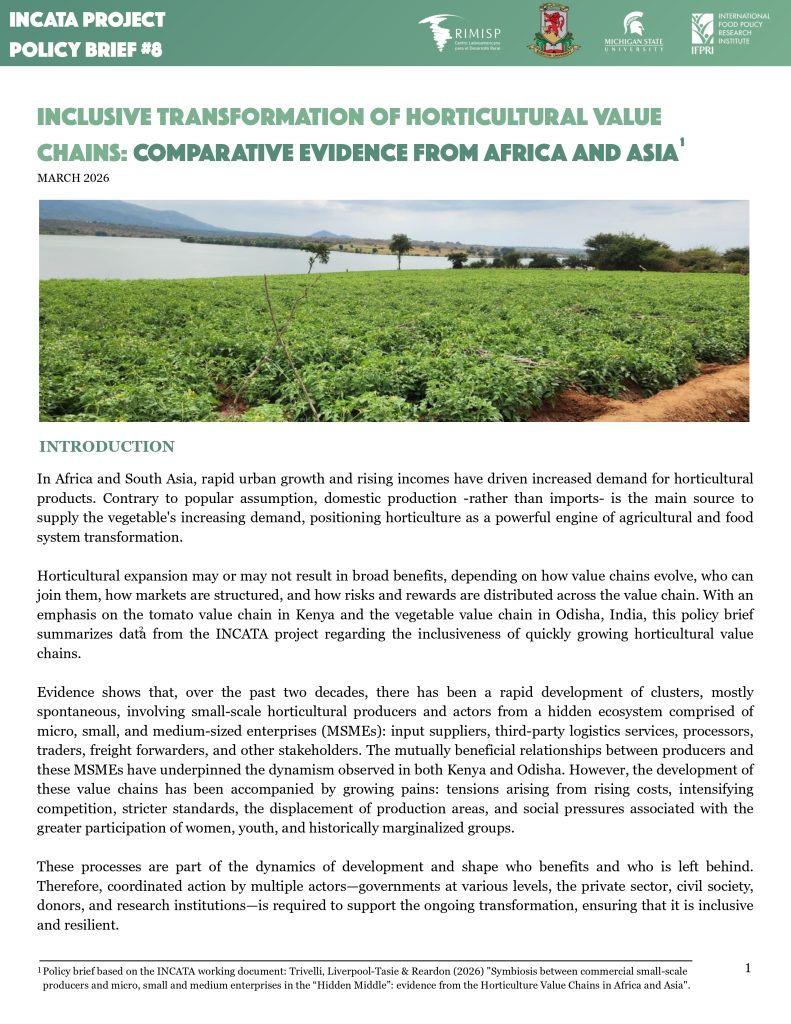
Policy Brief N°8 🇬🇧

Inclusive Transformation of Horticultural Value Chains: Comparative Evidence from Africa and Asia


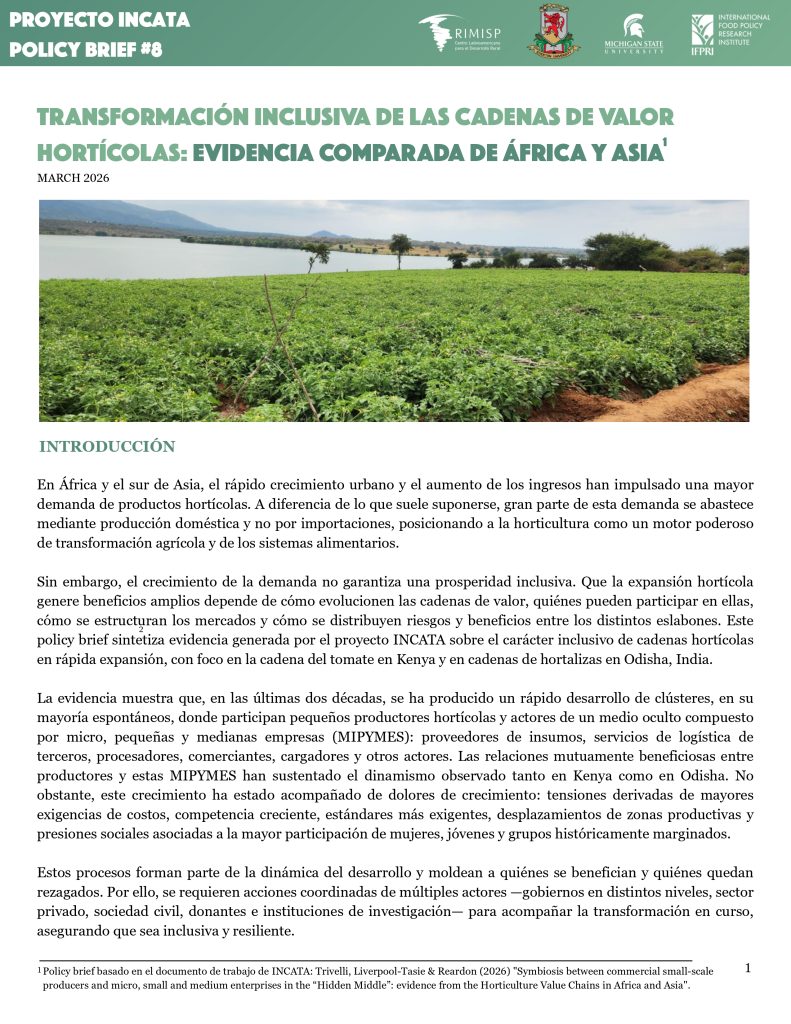
Policy Brief N°8 🇪🇸

Transformación inclusiva de las cadenas de valor hortícolas: evidencia comparada de África y Asia


Project Research Briefs

Research Brief N°1

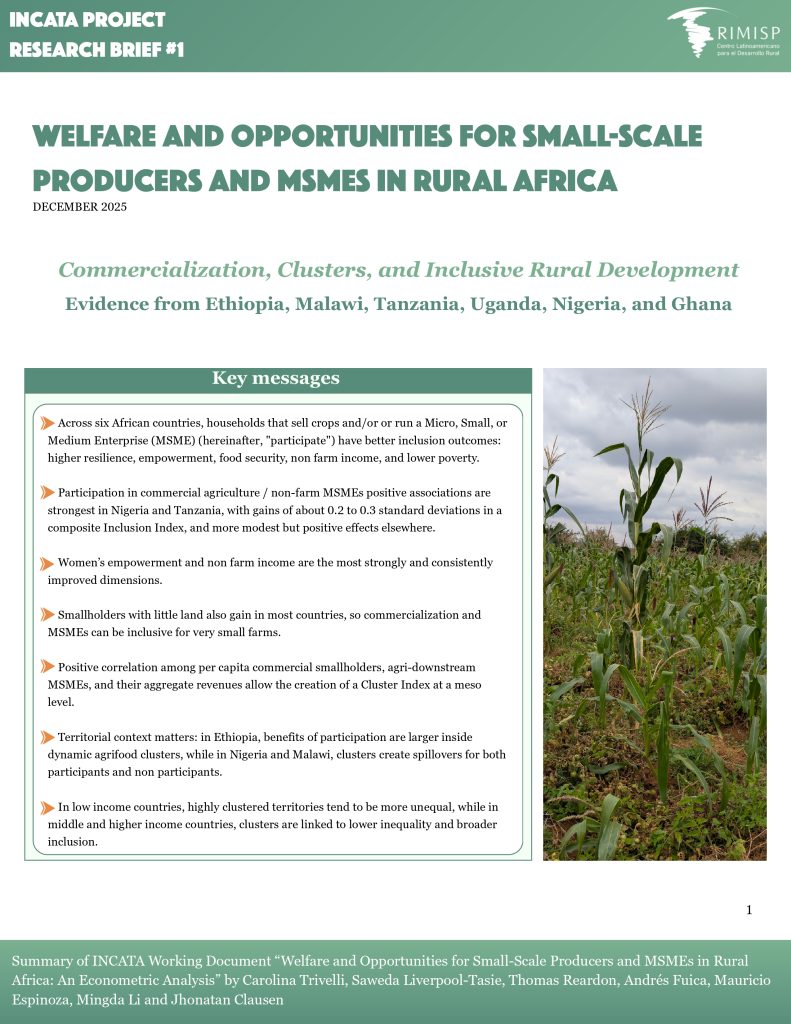
Welfare and Opportunities for Small-Scale Producers and MSMEs in Rural Africa

Commercialization, Clusters, and Inclusive Rural Development Evidence from Ethiopia, Malawi, Tanzania, Uganda, Nigeria, and Ghana. 


Research Brief N°2

Social learning, peer influence and smallholder commercialization

Evidence from six Sub-Saharan African countries (Ethiopia, Malawi, Tanzania, Uganda, Nigeria, and Ghana).


Research Brief N°3

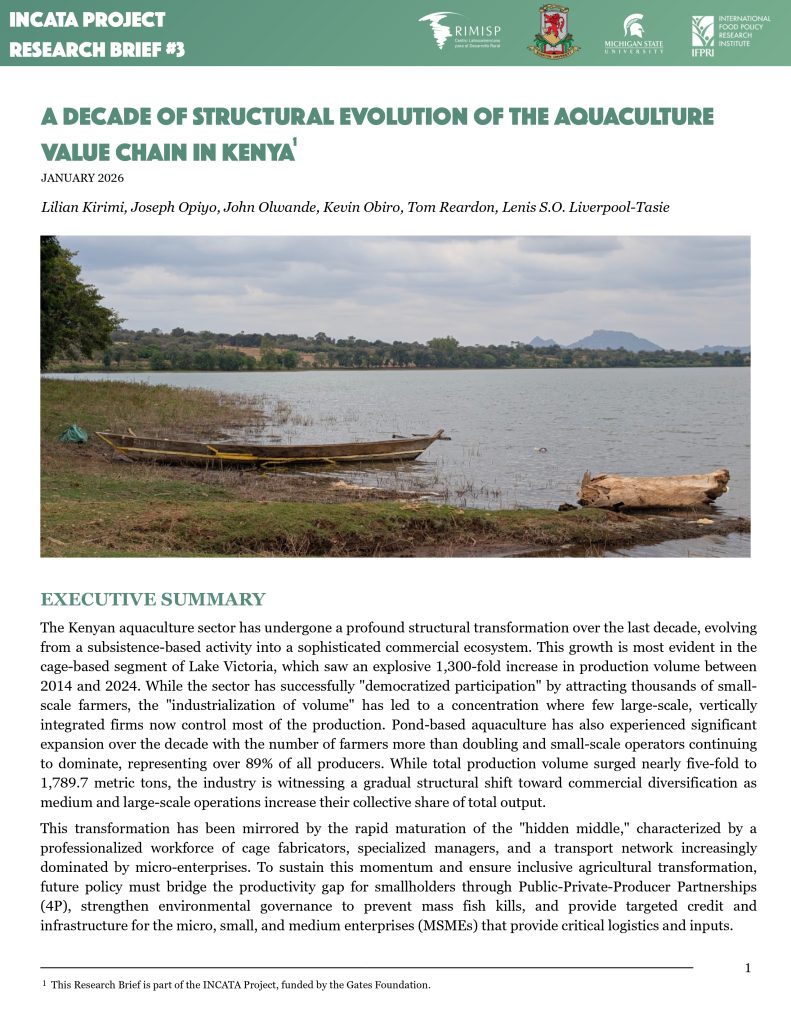
A Decade of Structural Evolution of the Aquaculture Value Chain in Kenya

This study examines the profound transformation of Kenya’s aquaculture sector from a subsistence-based activity into a sophisticated commercial ecosystem. It analyzes the explosive growth in cage and pond production, the “democratization of participation” among smallholders, and the rapid maturation of the MSMEs that constitute the value chain’s “hidden middle”.

Research Brief N°4

Driving Inclusive Agricultural Transformation. The Case of the Kenyan Tomato Value Chain

This study analyzes the twelve-fold expansion of Kenya’s tomato production volume and its evolution into a highly commercialized, technology-led ecosystem. It explores the symbiotic relationship between small-scale producers and the “hidden middle” of MSMEs, sustained by universal digital connectivity and mobile finance. The brief highlights the sector’s vital role in women’s economic empowerment and youth employment, while identifying urgent infrastructure deficits in wholesale markets.

Research Brief N°5

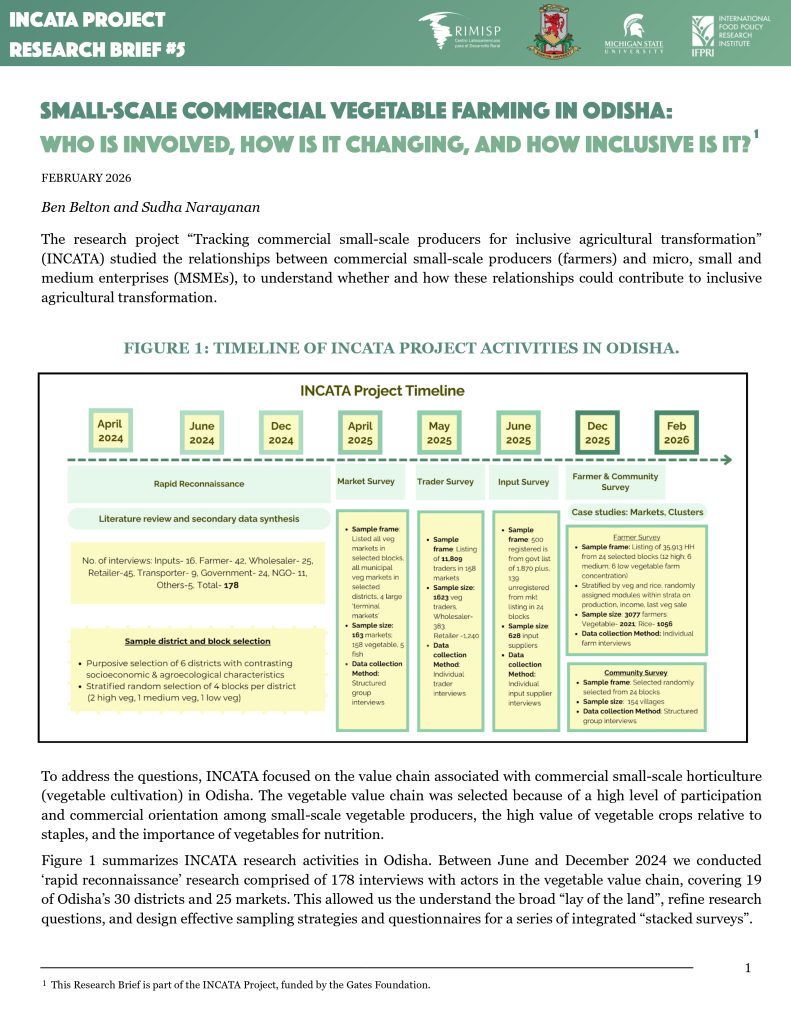
Small-scale Commercial Vegetable Farming in Odisha: Who is involved, how is it changing, and how inclusive is it?

This study identifies private irrigation as the primary catalyst for high-profit vegetable farming in Odisha, which generates 305% more profit per hectare than rice. It highlights how Agricultural Production Clusters (APCs) empower women from marginalized communities, significantly increasing their household agency, bargaining power, and diet diversity.

Research Brief N°6

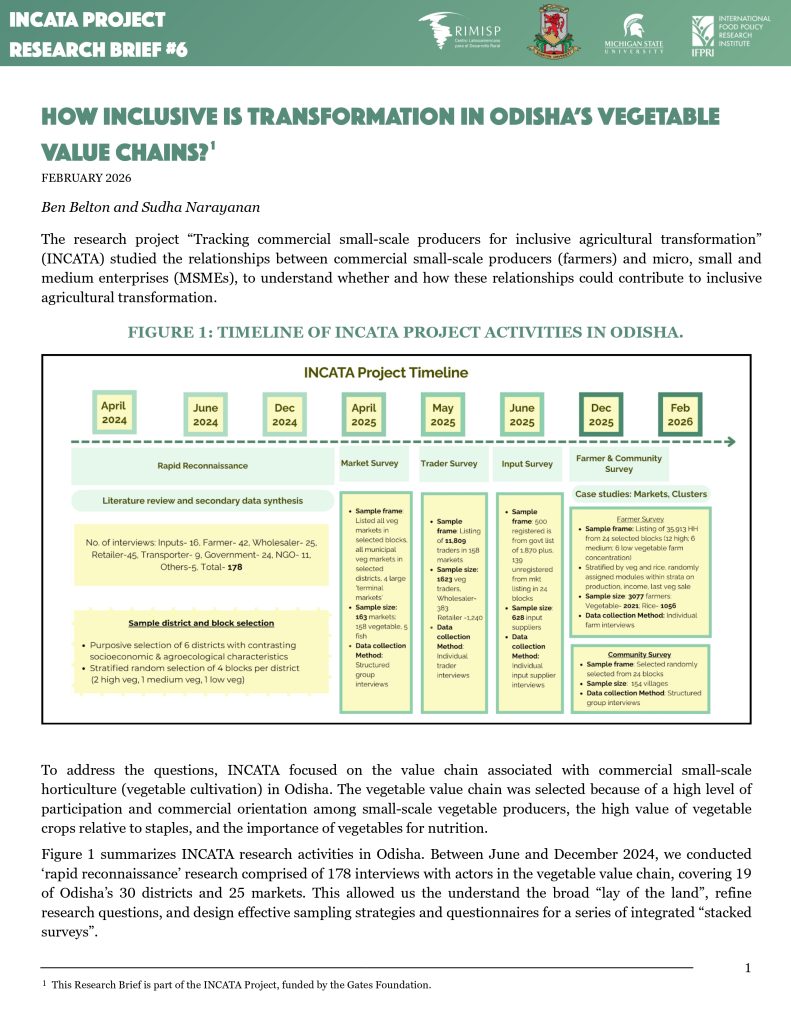
How Inclusive is Transformation in Odisha’s Vegetable Value Chains?

This study evaluates the inclusiveness of Odisha’s rapidly transforming vegetable markets, where traded volumes have surged by 74% over the last decade. While findings indicate that value chain relationships are largely trust-based and symbiotic, inclusion remains highly uneven across different nodes. Women and marginalized groups face significant capital disadvantages in retail, whereas high-value segments like wholesaling remain dominated by non-scheduled caste men.
Research Brief N°7

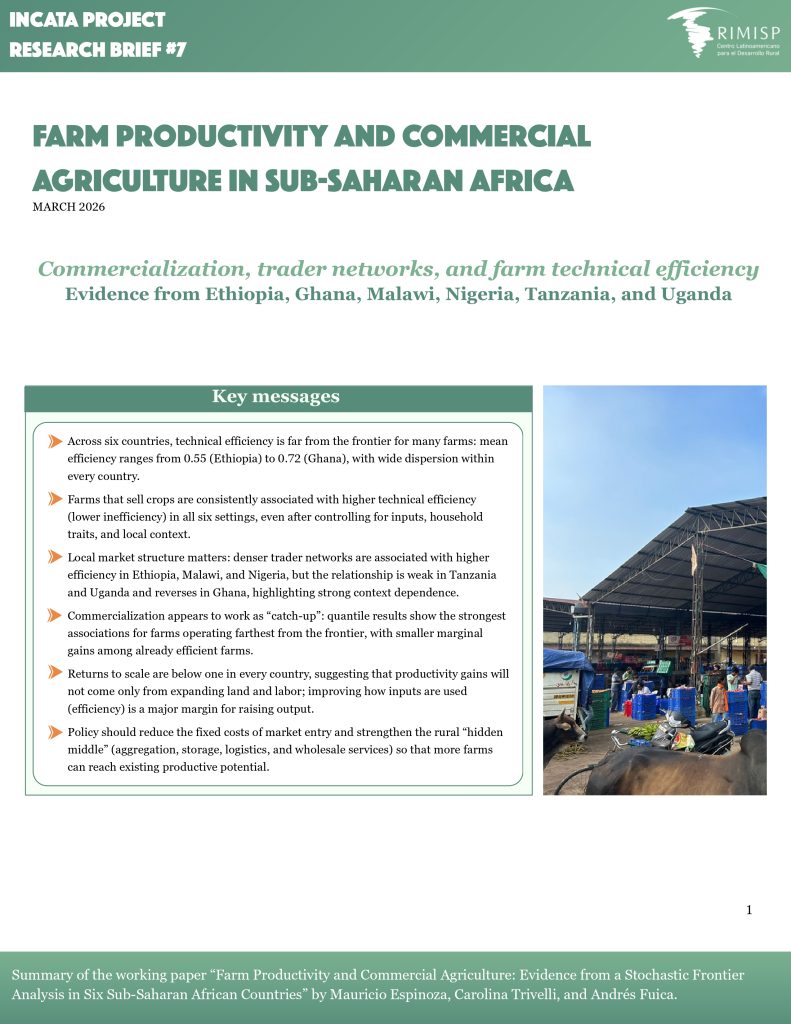
Farm Productivity and Commercial Agriculture in Sub-Saharan Africa

Across six countries, technical efficiency is far from the frontier. Farms that sell crops are consistently associated with higher technical efficiency, acting as a “catch-up” for those operating farthest from the frontier. Improving how inputs are used is a major margin for raising output. Policy should reduce fixed costs of market entry and strengthen the rural “hidden middle” so more farms reach existing productive potential.

Research Brief N°8

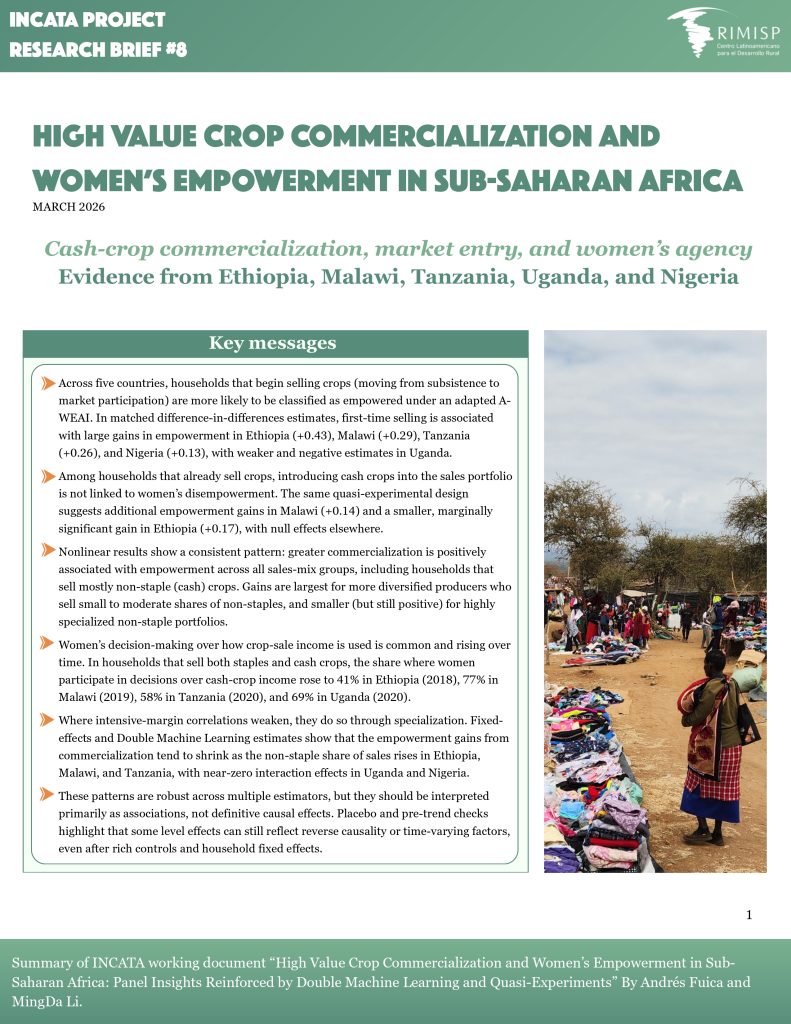
High Value Crop Commercialization and Women’s Empowerment in Sub-Saharan Africa

Households moving from subsistence to market participation are more likely to be classified as empowered. First-time selling is associated with large empowerment gains in Ethiopia, Malawi, Tanzania, and Nigeria. Introducing cash crops is not linked to disempowerment; women’s decision-making over income is common and rising. Recommendations include prioritizing first-sale entry and promoting gradual diversification over specialization.

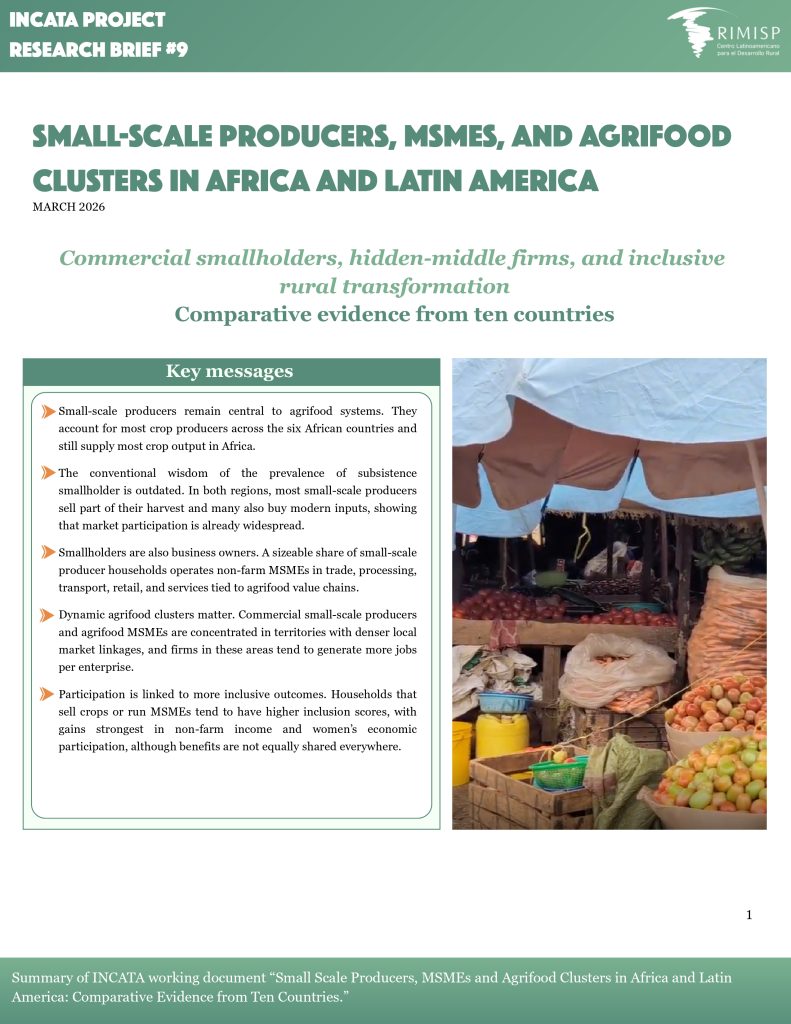
Research Brief N°9

Small-Scale Producers, MSMEs, and Agrifood Clusters in Africa and Latin America

This brief highlights how smallholders anchor agrifood systems through active market participation and non-farm MSME ownership. These “hidden middle” actors drive inclusive growth within dynamic territorial clusters, particularly benefiting women’s economic participation. To sustain this transformation, policy must shift toward supporting infrastructure and services beyond the farm gate.

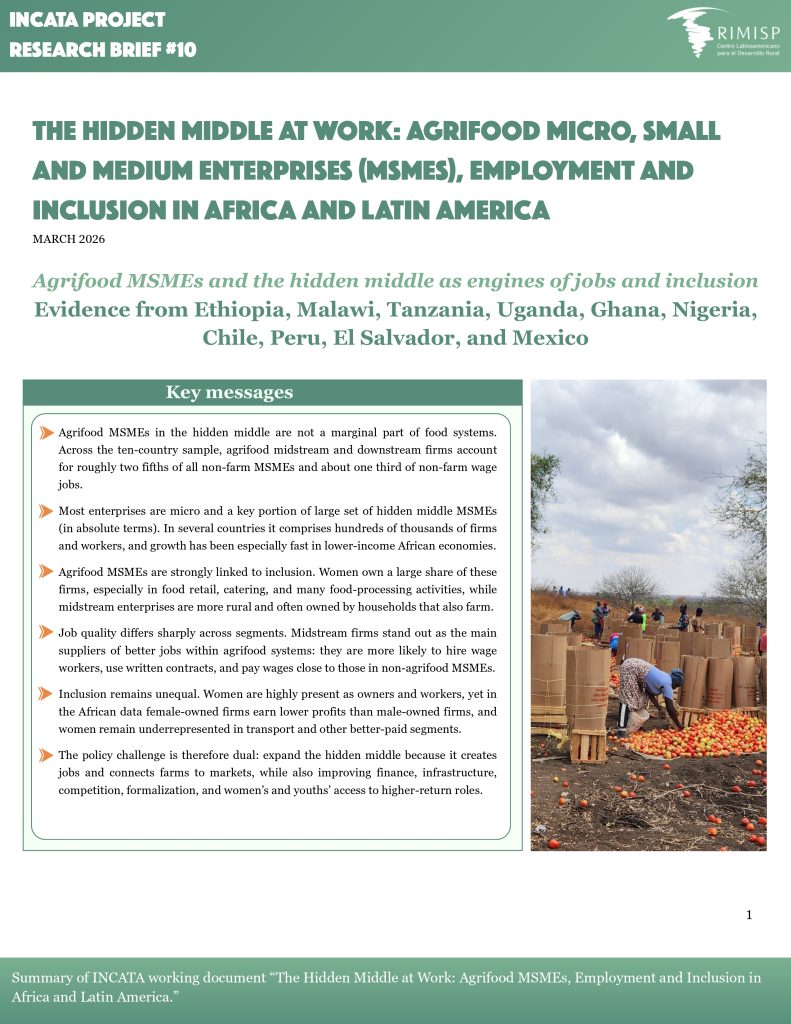
Research Brief N°10

The Hidden Middle at Work: Agrifood Micro, Small and Medium Enterprises (MSMEs), Employment and Inclusion in Africa and Latin America

Hidden middle agrifood MSMEs account for 40% of non-farm firms and a third of wage jobs. Midstream enterprises offer better wages and contracts than retail, though female owners face persistent profit gaps. Used by farmers to diversify income, these firms require targeted infrastructure and financial support to drive inclusive growth.

Presentations in external meetings

Presentation main messages of the INCATA Project during the INCATA Final Workshop held in Nairobi, Kenya, on February 4, 2026. 

Presentation entitled “Tomato Value Chain in Kenya” during the INCATA Final Workshop held in Nairobi, Kenya, on February 4, 2026. 

Ben Belton & Sudha Narayanan from the IFPRI South Asia Office gave a presentation entitled “Inclusive Agricultural Transformation in Odisha’s Vegetable Value Chains” during the INCATA Final Workshop held in Nairobi, Kenya, on February 4, 2026. 

The INCATA Leadership Team presented preliminary project findings at the offices of ECLAC in Santiago de Chile, on December 9, 2025. The presentation focused particularly on new data related to the “Hidden Middle” in agri-food value chains. 

On November 11th, the INCATA leadership team presented key messages from the project at the Gates Foundation in Seattle, USA.


During the 18th Congress of the European Association of Agricultural Economists (EAAE) in Bonn, Germany, held from 26 to 29 August 2025, members of the INCATA team shared preliminary findings on inclusion in Odisha’s vegetable value chains. Their presentation on 28 August 2025 was titled “Who participates in Odisha’s vegetable value chains, and on what terms?”.

Nuestras oficinas: