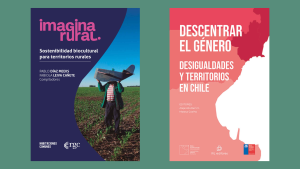
Researchers contributed to publications aimed at contributing to the debate on territorial and rural issues.
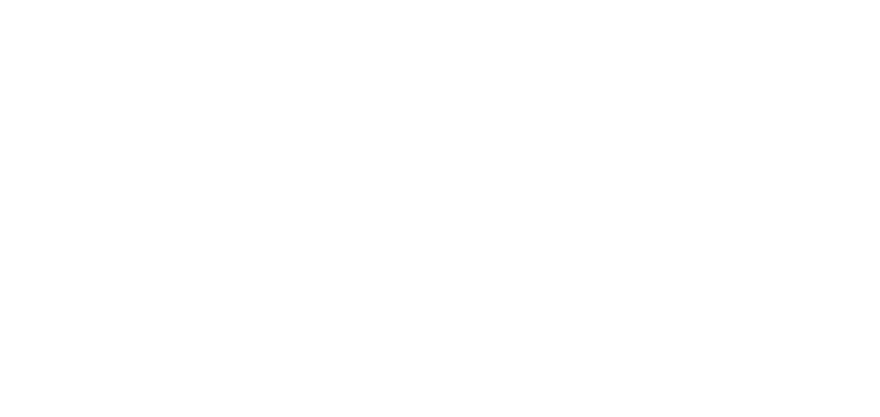
A delegation of 16 representatives from the La Libertad region (Peru)—composed of members of the public sector, academia, and civil society—learned about Chilean experiences in public policy, productive development, and rural development.
The “Crecer Rural: Innovative Initiatives to Strengthen Rural Economies, with a Focus on Gender and the Circular Economy in La Libertad”, implemented by CEDEPAS Norte with the support of Manos Unidas, held a technical internship in Santiago, Chile, from August 25 to 27. This exchange benefited from the ongoing collaboration of Rimisp—Latin American Center for Rural Development, an institution that provided guidance and supported the strategic coordination of the agenda in the country.
The main objective of the internship was to gain firsthand insight into Chile’s experiences in the design and implementation of public policies, strategies for promoting production, regional innovation, and the inclusion of smallholder family farming, in order to identify lessons that could be applied to rural areas in northern Peru.
To this end, a delegation composed of 16 representatives from local governments, public services, rural development institutions, academia, and civil society organizations in the La Libertad region traveled to Chile. Notable among the participating institutions were representatives from various provincial and district municipalities, AGRORURAL, Agroideas, the La Libertad Regional Agriculture Office (GRALL), the Julcán Agricultural Agency, the Ciro Alegría National University (UNCA), and professionals from CEDEPAS Norte.
WORK AGENDA AND TECHNICAL EXCHANGE
The technical internship included a three-day schedule:
The “Crecer Rural” program is an initiative implemented by CEDEPAS Norte, with the support of Manos Unidas, aimed at strengthening rural economies in the La Libertad region of Peru through the adoption of sustainable circular economy practices, promoting entrepreneurship with a focus on gender equity, and strengthening local governance and institutional capacity. By building networks among producers, public entities, academia, and civil society, the program seeks to revitalize the local economy and improve development opportunities in rural areas of Peru.
Researchers contributed to publications aimed at contributing to the debate on territorial and rural issues.
A new Rimisp report explores the evolution of public policies aimed at smallholder family farming in Chile, identifying the various...
As part of the Connected Communities project, the three courses of the “Digital Transformation for Family Farming” Training Program concluded...