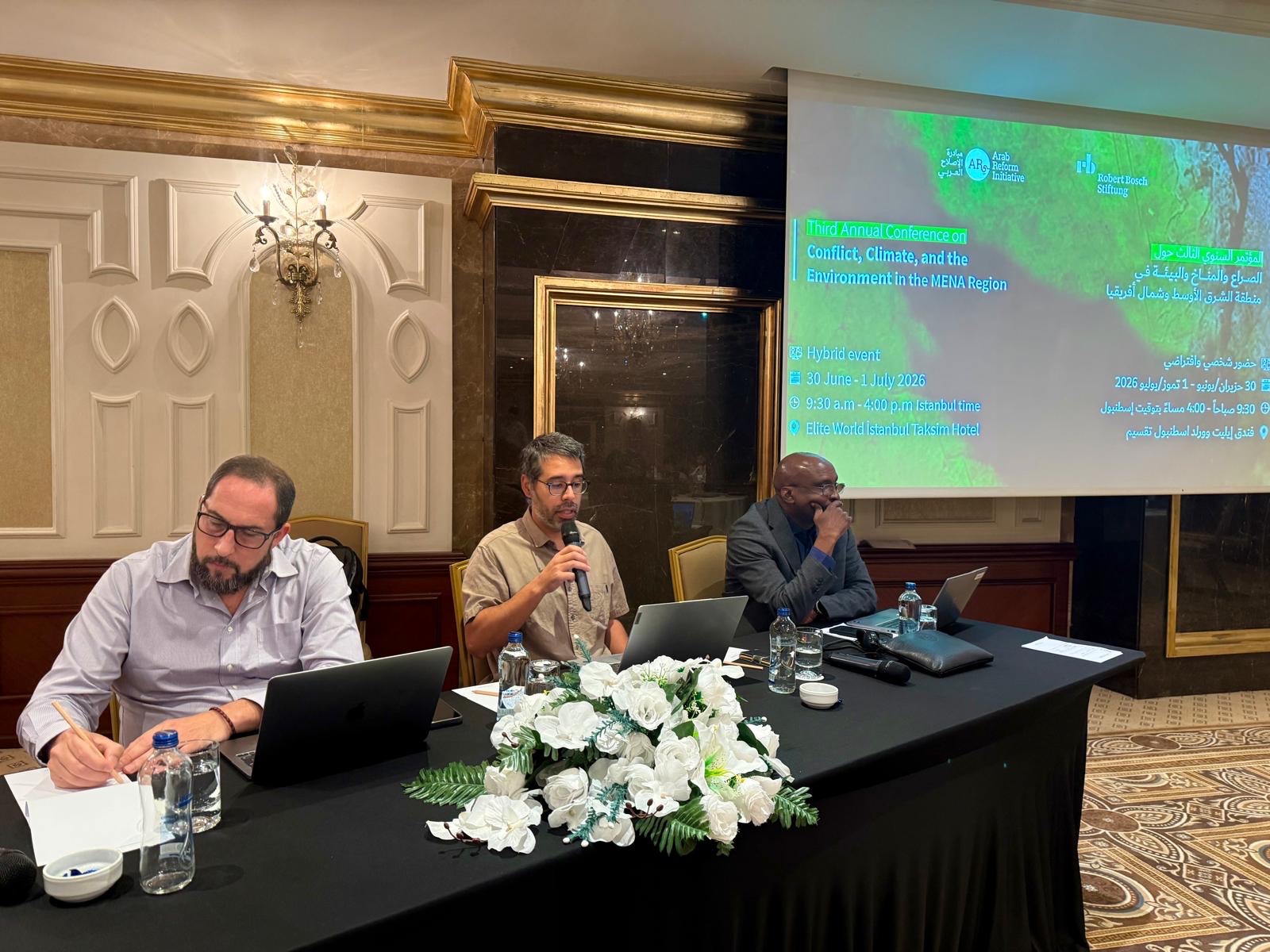
Between June 30 and July 1, 2026, the third annual conference titled “Crossroads of Crisis: Conflict, Climate Change, and the Environment in the MENA Region” was held in Istanbul, Turkey. Organized by the Arab Reform Initiative (ARI) and the Robert Bosch Stiftung (RBSG), the meeting’s main objective was to understand, highlight, and discuss the environmental impact caused by armed conflicts in the Middle East and North Africa (MENA) region. The event brought together various international experts and scholars to examine how political and military crises severely degrade natural resources, destroy essential water and sanitation infrastructure, and drastically reduce the capacity of communities and states to respond to environmental degradation.
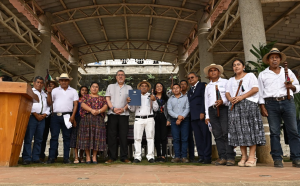
In this context, Rimisp Director Rodrigo Yáñez participated in Panel 7 of the conference, titled “Lessons and Experiences from Beyond MENA: Documenting Conflict-Driven Environmental Destruction”, a forum designed to provide a comparative perspective based on lessons learned from other regions, such as Africa and Latin America. During his presentation, Yáñez described the initiative carried out in collaboration with indigenous peoples in the “Networks for Agri-Food Transformation” Project, detailing how, through networking, they have been able to support documentation and advocacy processes aimed at transforming food systems at the municipal level (Torotoro, Bolivia), state level (Sierra Norte de Puebla, Mexico), and national level (Alta Verapaz, Guatemala). Also speaking at the event was Ricardo Fort, a senior researcher at GRADE in Peru, who addressed the development of a South-South agenda on natural resources and the commons, joining the African presentations by Ukoha Ukiwo, team leader of Strengthening Peace and Resilience in Nigeria, and Negasi Solomon, principal researcher at the Tigray Institute of Policy Studies in Ethiopia, who presented on programs to address internal violence and document ecological damage on the African continent.
During the conference, one of the main topics of discussion was the impact of direct wartime violence on ecosystems and the urgent need to criminalize such actions. In this regard, Yáñez highlighted the emergence of new international legal frameworks for documenting these violations: “Ecocide is a new concept that is currently being developed. This concept aims to show how we can demonstrate that violence is not only perpetrated against human beings, but that there is also a strategy of war against nature, which affects human life in other ways. Because when you put pressure on nature—by bombing fields, cutting down trees, polluting rivers, causing population displacement, and straining food systems—you trigger a series of phenomena, such as famines and an increase in the number of refugees, which further destabilizes countries “.
In turn, the director of Rimisp notes that the seminar addressed the importance of considering nature as a central element of war—one that is not always treated as a priority, since attention tends to focus on human life. “This is a complex issue that can be approached from an ethical perspective, but it has very concrete implications. If you don’t care about the environment, you have no way of restoring communities and human life in those areas either. If the land does not recover, agriculture and traditions are lost, the population migrates and settles on the outskirts of large cities or in camps, and problems such as unemployment and food insecurity begin, among others. There was much discussion about how war transforms human life as well as people’s livelihoods “.
The conference provided a platform to showcase the lessons learned from Rimisp’s regional work in Latin America on the global stage and strengthen strategic ties around a South-South agenda for technical and methodological cooperation. The meeting concluded by reaffirming the urgency of bindingly integrating the environmental dimension into rural recovery and development plans, recognizing that the scientific standardization of evidence and ecological restoration are fundamental pillars for safeguarding food sovereignty and the sustainable well-being of rural communities globally. .