Transformación inclusiva de las cadenas de valor hortícolas: evidencia comparada de África y Asia
En África y el sur de Asia, el rápido crecimiento urbano y el aumento de los ingresos han impulsado una mayor demanda de productos hortícolas. A diferencia de lo que suele suponerse, gran parte de esta demanda se abastece mediante producción doméstica y no por importaciones, posicionando a la horticultura como un motor poderoso de transformación agrícola y de los sistemas alimentarios.
Inclusive Transformation of Horticultural Value Chains: Comparative Evidence from Africa and Asia
In Africa and South Asia, rapid urban growth and rising incomes have driven increased demand for horticultural products. Contrary to popular assumption, domestic production -rather than imports- is the main source to supply the vegetable’s increasing demand, positioning horticulture as a powerful engine of agricultural and food system transformation.
Symbiosis Between Commercial Small-Scale Producers and Micro, Small and Medium Enterprises in the “Hidden Middle”: Evidence from the Horticulture Value Chains in Africa and Asia
Rapid urbanization and changing diets in Africa and South Asia are raising demand for horticultural products, creating opportunities for agrifood transformation. This report synthesizes evidence from the INCATA project (Linked Farms and Enterprises for Inclusive Agricultural Transformation in Africa and Asia). It finds that small-scale producers are highly commercial and often embedded in mutually beneficial relationships with micro, small, and medium enterprises (MSMEs) in the “hidden middle” of input supply, trading, logistics, and related services.
Farm Transformation of the Tomato Value Chain in Kenya
The Kenyan tomato value chain represents a hallmark of agricultural transformation, characterized by a massive twelve-fold expansion in production volume between 1980 and 2022 to meet a five-fold increase in domestic consumption.
Transformation of the Aquaculture Value Chain in Kenya
The Kenyan aquaculture sector has undergone a profound structural transformation over the last decade, evolving from a subsistence-based activity into a sophisticated commercial ecosystem. This growth is most evident in the cage-based segment of Lake Victoria, which saw an explosive 1,300-fold increase in production volume between 2014 and 2024.
Rimisp y socios internacionales concluyen actividades del proyecto INCATA en Nairobi, Kenia

Rodrigo Yáñez y Andrés Fuica de Rimisp, junto a Carolina Trivelli del Instituto de Estudios Peruanos (IEP), participaron el pasado 4 de febrero, en Nairobi, Kenia, del evento público de cierre del proyecto INCATA.
Welfare and Opportunities for Small-Scale Producers and MSMEs in Rural Africa: An Econometric Analysis
This study examines how participation in commercial agriculture and micro, small, and medium enterprises (MSMEs) is associated with inclusive development outcomes for small-scale producers (SSPs) across six African countries representing diverse income levels.
El rol del “eslabón oculto” en los sistemas agroalimentarios marcó el debate del Seminario Internacional del proyecto INCATA
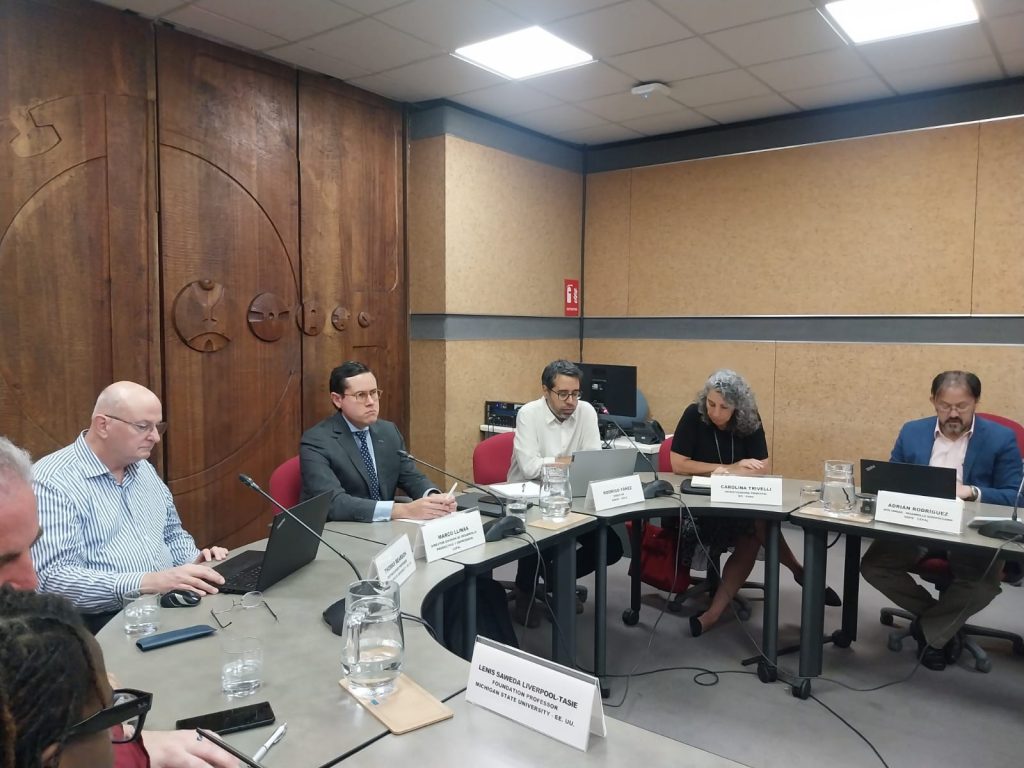
En el marco del proyecto INCATA, expertos internacionales se reunieron para debatir cómo la articulación entre pequeños productores y las MIPYMES agroalimentarias impulsa el desarrollo rural en África, Asia y América Latina.
The hidden middle of agrifood systems: a systematic review of leading authors and policy recommendations
This report synthesizes the literature on the Hidden Middle of agrifood systems—the midstream segment that connects producers to markets through processing, logistics, and intermediation.
Evidence Review: Investments and Policies in Agrifood Chain Linkages
Agrifood systems are increasingly shaped by activities beyond the farm gate, yet the midstream and
downstream segments—known as the hidden middle—remain severely under-researched. This paper
presents a review of 276 impact evaluations and systematic reviews to assess what is currently known
about effective policies and programs targeting the hidden middle in low- and middle-income
countries. While 52% of the studies focus on smallholder-oriented interventions and 21% on public
goods, only 27% address the hidden middle, and nearly half of these concern contract farming—a
mechanism designed to bypass intermediaries rather than strengthen them. Most intervention
categories in the midstream and downstream are supported by fewer than four rigorous studies.
Moreover, services like storage, training, and market information are evaluated almost exclusively in
the context of producers, ignoring the micro, small, and medium enterprises (MSMEs) that dominate
the hidden middle. The paper concludes that addressing this evidence gap is essential to designing
inclusive, resilient agrifood systems and calls for a shift in research and policy focus toward the actors
and services that connect farms to markets and consumers.