Project partners – INCATA
Facebook Instagram Twitter Youtube Linkedin Project partners Michigan State University, Department of Agricultural, Food, and Resource Economics The Department of Agricultural, Food, and Resource Economics (AFRE) at Michigan State University is dedicated to improving lives through management and economics. With over 50 faculty members, 60 graduate students, and 400 undergraduate students, AFRE tackles societal policy […]
Countries – INCATA
Facebook Instagram Twitter Youtube Linkedin Countries The project will focus on research in seven Sub-Saharan African countries: Ethiopia, Ghana, Kenya, Malawi, Nigeria, Tanzania, and Uganda, as well as in Odisha, India. Facebook Instagram Twitter Youtube Linkedin Nuestras oficinas: Chile: Huelén 10. Providencia, Santiago, Región Metropolitana. (+56-2) 2236 4557 | Fax (+56-2) 2236 4558. Ecuador: Checoslovaquia […]
About the project – INCATA
Facebook Instagram Twitter Youtube Linkedin About the project What is INCATA? INCATA is an innovative project funded by the Gates Foundation designed to study the relationship between commercial small-scale producers (cSPP) and micro, medium and small enterprises (MSME) in the hidden middle of agrifood value chains, to explain how it underpins and contributes to an […]
INCATA: Linked Farms and Enterprises for Inclusive Agricultural Transformation in Africa and Asia
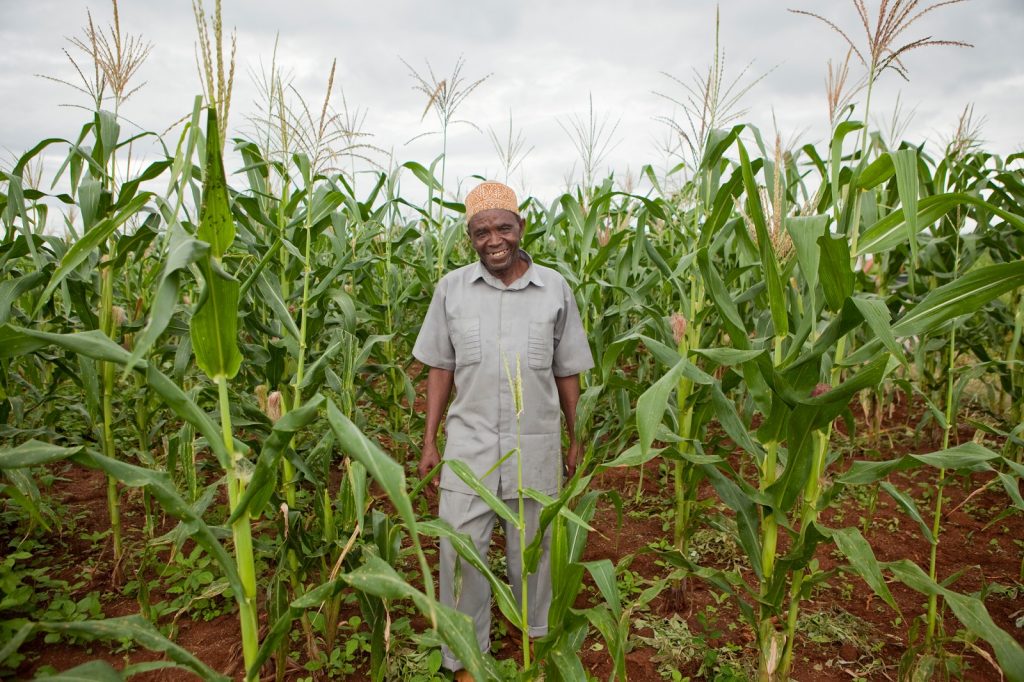
INCATA is an innovative project designed to study the relationship between cSPP and MSME in the hidden middle of agrifood value chains, to explain how it underpins and contributes to an inclusive agricultural transformation.
Strengthening coherence between social protection and productive interventions in four African countries
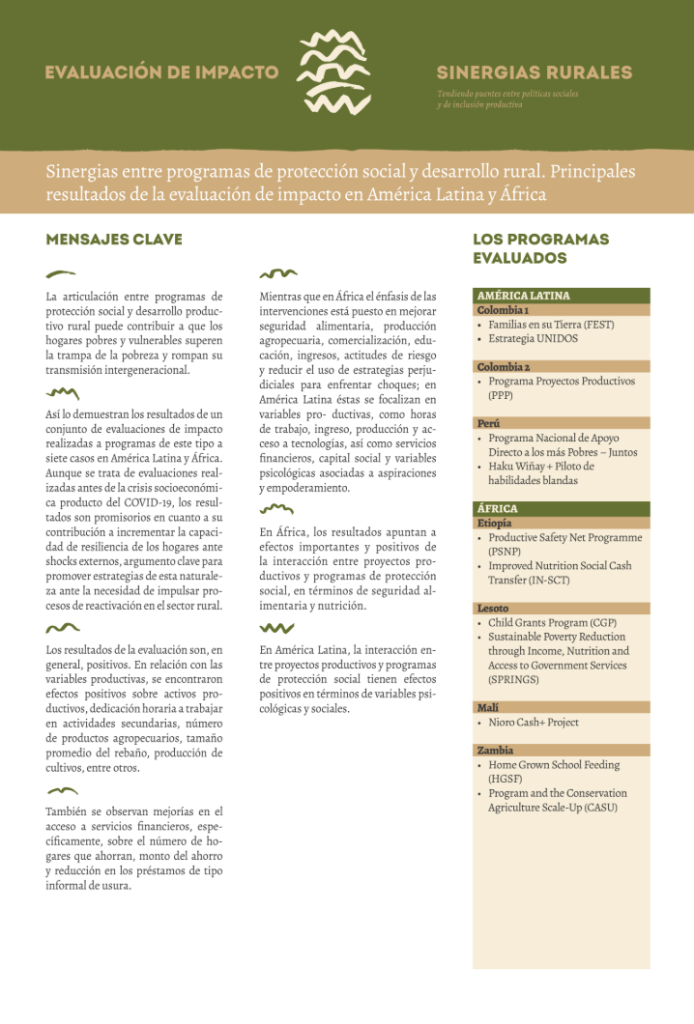
This policy brief discusses how linking social protection and rural development programs can help vulnerable households escape poverty and increase their resilience to shocks. It highlights findings from studies in Ethiopia, Lesotho, Mali, and Zambia.
Improving coordination and synergy between social protection and agriculture in Ethiopia
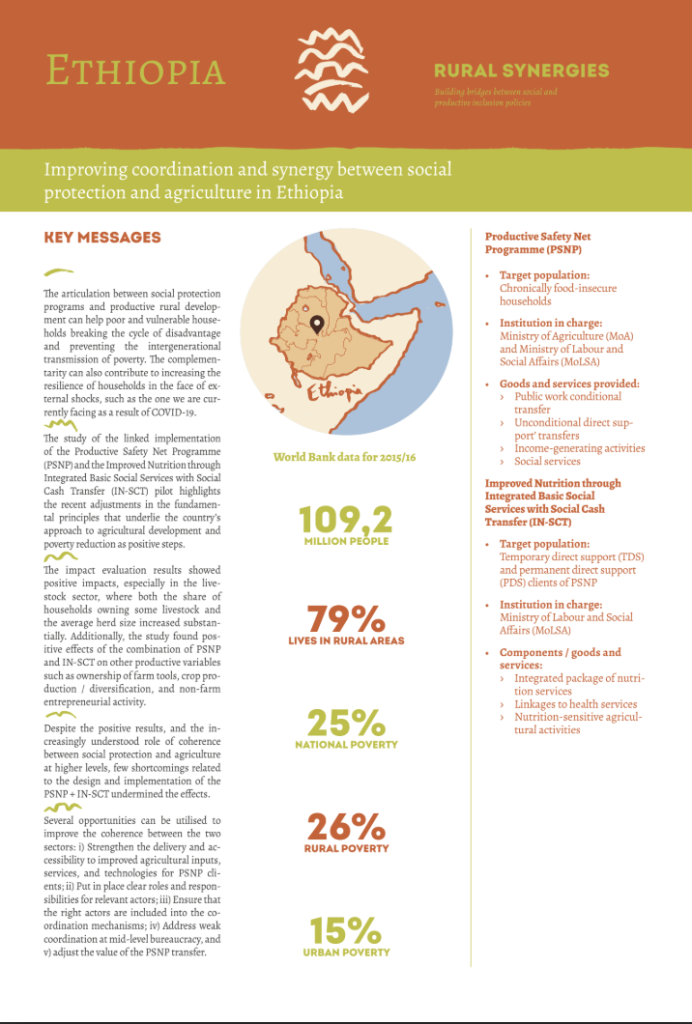
This policy brief, highlights how linking social protection and rural development programs can help vulnerable households escape poverty and increase their resilience to external shocks, like COVID-19. The study focuses on Ethiopia’s Productive Safety Net Programme (PSNP) and the Improved Nutrition through Integrated Basic Social Services with Social Cash Transfer (IN-SCT) pilot.
Africa: Building bridges between social and productive inclusion policies

Strengthening coherence between social
protection and productive interventions in
four African countries
Ethiopia: Building bridges between social and productive inclusion policies

Ethiopia has a land area of 1.1 million km2 and a population of more than 100 million. Its economy is largely based on agriculture, which employs two
thirds of the population and accounts for about one third (31.2 percent) of its gdp (world development indicators). Most of the agricultural sector is based on smallholder farmers, who produce about 94
percent of the country’s food crops and 98 percent of the coffee. A sizeable proportion of the rural population depends on social protection to bridge the food gap arising from recurrent drought and other shocks. This implies that both social protection and agriculture are important sectors to address food insecurity and poverty in rural ethiopia. They should therefore be planned and implemented in an integrated and coherent manner.