Strengthening coherence between social protection and productive interventions in four African countries
This policy brief discusses how linking social protection and rural development programs can help vulnerable households escape poverty and increase their resilience to shocks. It highlights findings from studies in Ethiopia, Lesotho, Mali, and Zambia.
Institucionalidad para la articulación entre programas de protección social y desarrollo productivo rural. Experiencias en América Latina y África
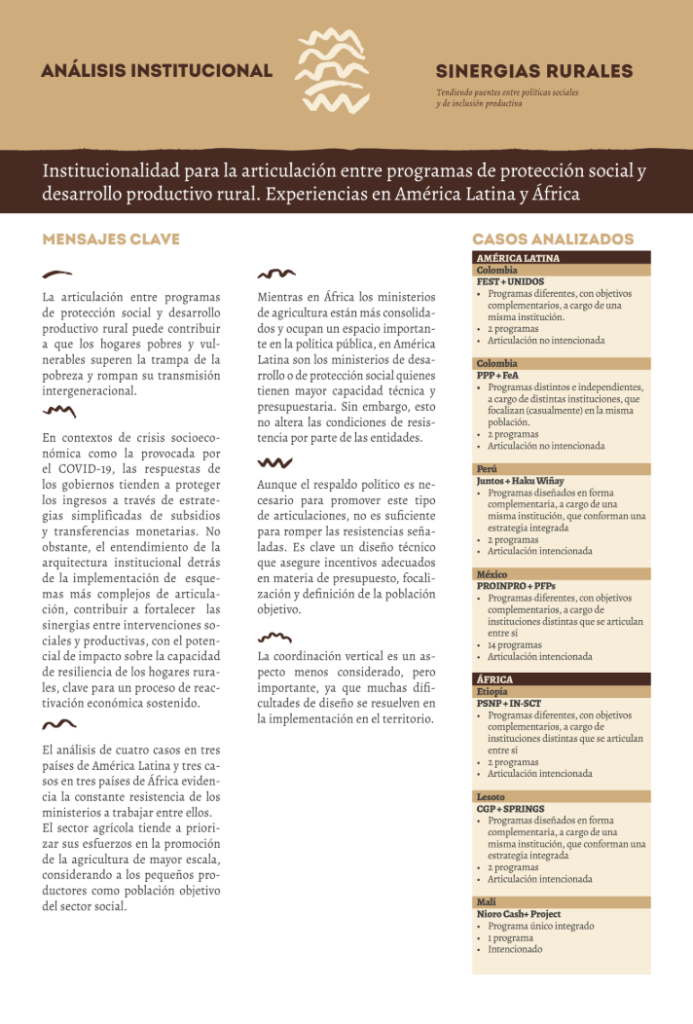
Este policy brief presenta un análisis institucional sobre la articulación entre programas de protección social y desarrollo productivo rural en América Latina y África, buscando contribuir a que los hogares pobres superen la trampa de la pobreza.
Harnessing the synergies between social protectionand agriculture in Zambia
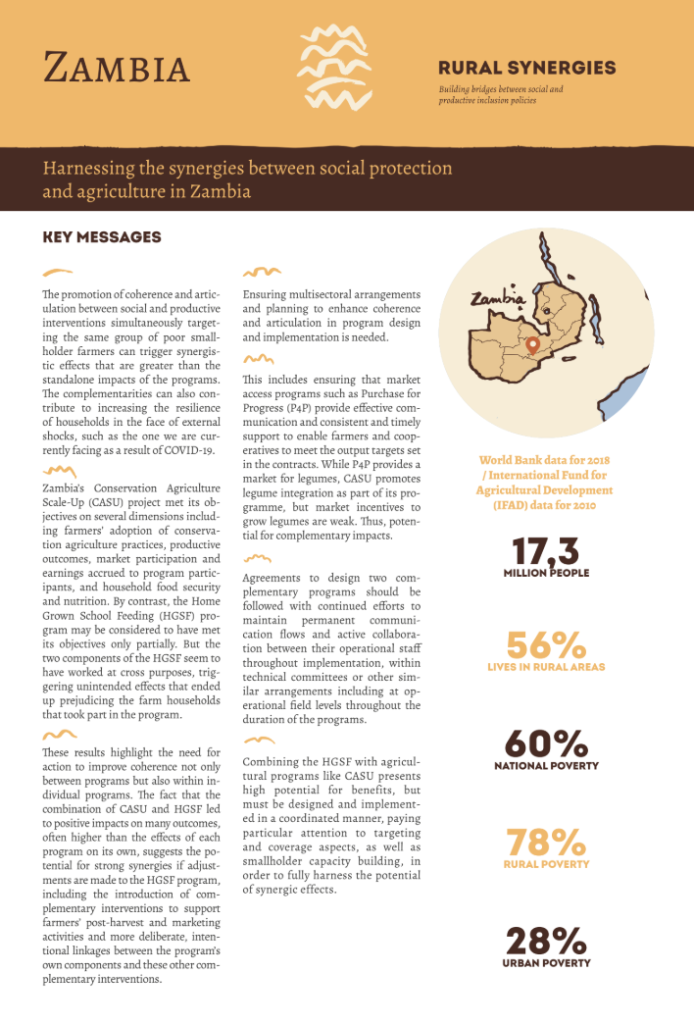
This Policy Brief, emphasizes the benefits of combining social protection and agricultural interventions in Zambia.
Africa: Building bridges between social and productive inclusion policies

Strengthening coherence between social
protection and productive interventions in
four African countries
Zambia: Building bridges between social and productive inclusion policies

Zambia enjoyed strong economic growth between 2004 and 2014, which benefited small segments of the
urban population. Because growth was accompanied by increased inequality, its effects on poverty reduction were limited. In 2015, 58 percent of zambians were below the international poverty line of $1.90 per day and three quarters of the poor lived in rural areas. To contain
inequality, bring people out of poverty and improve the lives of the most vulnerable, the government of zambia
committed to expand social protection expenditure
in the 2019 budget by 18 percent from the previous year, following a series of consecutive expansions of this
sector. Nevertheless, in 2019 zambia still spent only 0.7 percent of the country’s gdp on social protection,
lagging behind the regional average.
Sinergias Rurales
El objetivo del proyecto fue brindar evidencia a formuladores de política sobre los beneficios de las intervenciones articuladas de desarrollo productivo y protección social, para generar una amplia base de casos documentados que permitan la discusión y la comparación a nivel regional e interregional, tanto sobre los efectos generados en los hogares rurales, como sobre las características institucionales que facilitan o dificultan la articulación de las intervenciones.