Strengthening coherence between social protection and productive interventions in four African countries
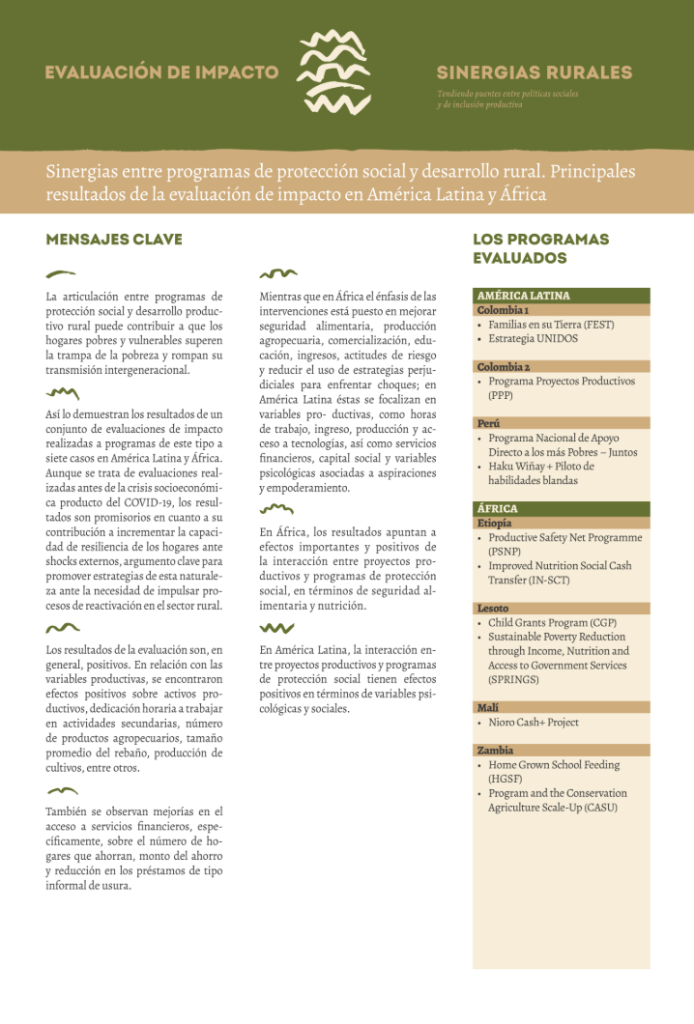
This policy brief discusses how linking social protection and rural development programs can help vulnerable households escape poverty and increase their resilience to shocks. It highlights findings from studies in Ethiopia, Lesotho, Mali, and Zambia.
Leveraging social protection to support economic inclusion in Lesotho
This policy brief, “Leveraging social protection to support economic inclusion in Lesotho,” highlights how combining social protection programs with rural livelihood interventions can create synergies to address the constraints faced by poor rural households in Lesotho.
Africa: Building bridges between social and productive inclusion policies
Strengthening coherence between social
protection and productive interventions in
four African countries
Lesotho: Building bridges between social and productive inclusion policies
Lesotho has demonstrated strong commitment towards
addressing poverty and vulnerability through social
protection. In 2017-18, lesotho’s social assistance
expenditure was 5.7% of its gdp, compared to about 1 to
2% in most other developing countries. A concerted
effort has been taken to implement a comprehensive
and coherent social protection strategy. The ministry
of social development (mosd), created in 2012, has been
leading this effort. The national social protection
strategy of 2015 aims to operationalize a set of
programmes, operated by various ministries, that seek
to reduce vulnerabilities across the life course of
individuals. Despite these attempts, intersectoral
coordination remains a challenge. In fact, the bulk
of social assistance expenditure and coverage sits
outside the ministry’s purview: more than 80% of the
government’s social assistance spending go to the
old age pension, managed by the ministry of finance,
a tertiary bursary programme implemented by the
ministry of development planning, and the national
school feeding programme managed by the ministry of
education and training.
Sinergias Rurales
El objetivo del proyecto fue brindar evidencia a formuladores de política sobre los beneficios de las intervenciones articuladas de desarrollo productivo y protección social, para generar una amplia base de casos documentados que permitan la discusión y la comparación a nivel regional e interregional, tanto sobre los efectos generados en los hogares rurales, como sobre las características institucionales que facilitan o dificultan la articulación de las intervenciones.