The Hidden Middle at Work: Agrifood MSMEs, Employment and Inclusion in Africa and Latin America
This report uses harmonized micro data from ten African and Latin American countries to describe the structure, growth and employment role of non-farm micro, small and medium enterprises (MSMEs) along the agrifood value chain.
Small Scale Producers, MSMEs and Agrifood Clusters in Africa and Latin America: Comparative Evidence from Ten Countries
This report uses harmonised household and enterprise microdata from six Sub Saharan African countries (Ethiopia, Ghana, Malawi, Nigeria, Tanzania, Uganda) and four Latin American countries (Chile, El Salvador, Mexico, Peru) to reassess the role of smallholders in agrifood transformation.
Transformación inclusiva de las cadenas de valor hortícolas: evidencia comparada de África y Asia
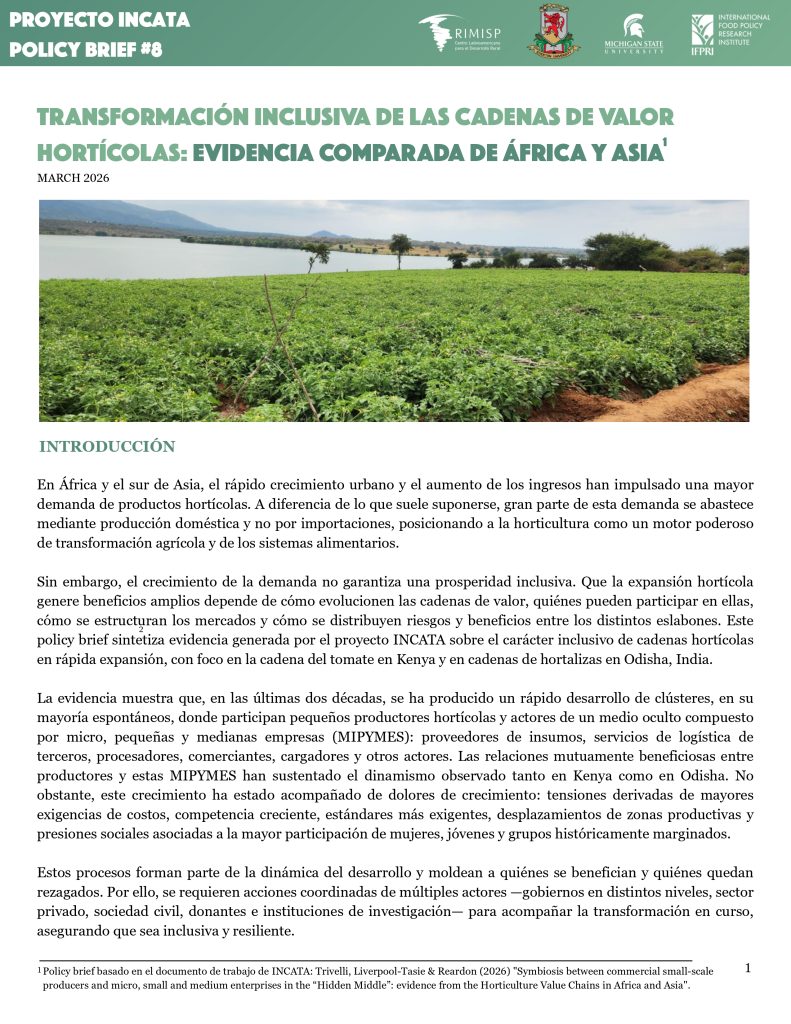
En África y el sur de Asia, el rápido crecimiento urbano y el aumento de los ingresos han impulsado una mayor demanda de productos hortícolas. A diferencia de lo que suele suponerse, gran parte de esta demanda se abastece mediante producción doméstica y no por importaciones, posicionando a la horticultura como un motor poderoso de transformación agrícola y de los sistemas alimentarios.
Inclusive Transformation of Horticultural Value Chains: Comparative Evidence from Africa and Asia
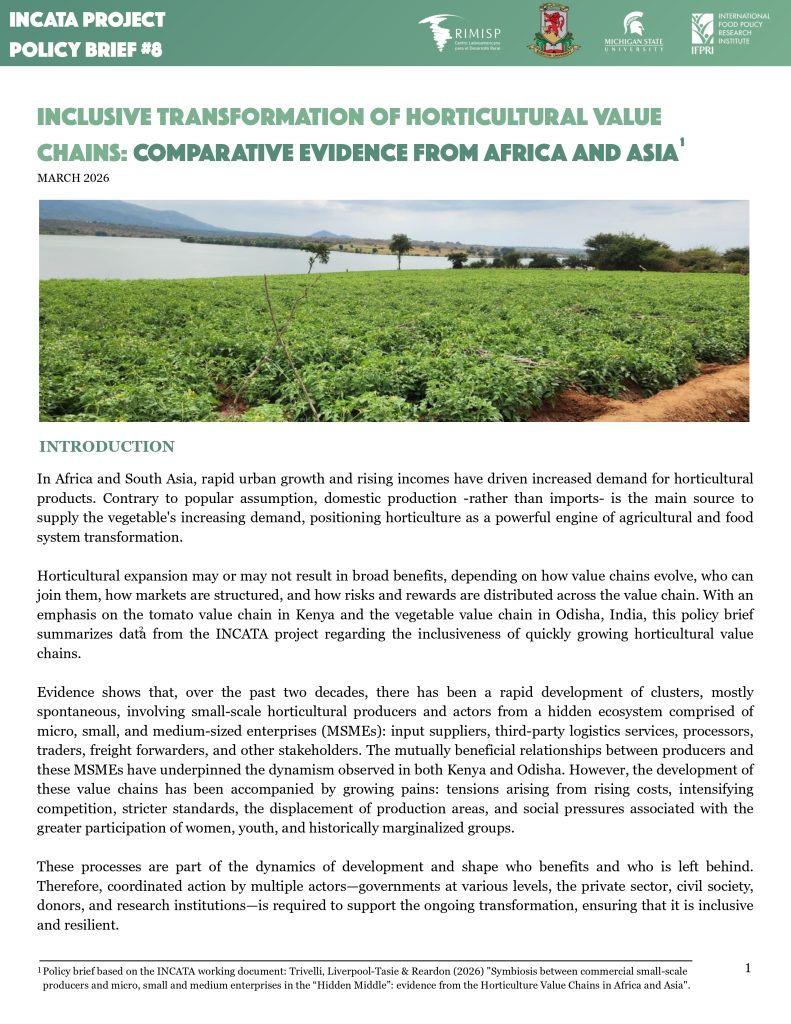
In Africa and South Asia, rapid urban growth and rising incomes have driven increased demand for horticultural products. Contrary to popular assumption, domestic production -rather than imports- is the main source to supply the vegetable’s increasing demand, positioning horticulture as a powerful engine of agricultural and food system transformation.
Symbiosis Between Commercial Small-Scale Producers and Micro, Small and Medium Enterprises in the “Hidden Middle”: Evidence from the Horticulture Value Chains in Africa and Asia
Rapid urbanization and changing diets in Africa and South Asia are raising demand for horticultural products, creating opportunities for agrifood transformation. This report synthesizes evidence from the INCATA project (Linked Farms and Enterprises for Inclusive Agricultural Transformation in Africa and Asia). It finds that small-scale producers are highly commercial and often embedded in mutually beneficial relationships with micro, small, and medium enterprises (MSMEs) in the “hidden middle” of input supply, trading, logistics, and related services.
Commercial small scale vegetable producers and inclusive agricultural transformation in Odisha
This report compiles findings from a research project titled “Tracking commercial small-scale producers for inclusive agricultural transformation” (INCATA), that studied the relationships between commercial small-scale producers (farmers) and micro, small, and medium enterprises (MSMEs) in vegetable value chains in Odisha, India.
Transformation of the Tomato Value Chain in Kenya
The Kenyan tomato value chain represents a hallmark of agricultural transformation, characterized by a massive twelve-fold expansion in production volume between 1980 and 2022 to meet a five-fold increase in domestic consumption.
Farm Productivity and Commercial Agriculture: Evidence from a Stochastic Frontier Analysis in Six Sub-Saharan African Countries
This paper examines whether farm-level commercialization and local intermediary density are associated with improvements in technical efficiency—that is, the extent to which producers operate close to their production frontier given available inputs.
Transformation of the Aquaculture Value Chain in Kenya
The Kenyan aquaculture sector has undergone a profound structural transformation over the last decade, evolving from a subsistence-based activity into a sophisticated commercial ecosystem. This growth is most evident in the cage-based segment of Lake Victoria, which saw an explosive 1,300-fold increase in production volume between 2014 and 2024.
High Value Crop Commercialization and Women’s Empowerment in Sub-Saharan Africa: Panel Insights Reinforced by Double Machine Learning and Quasi-Experiments
We examine how agricultural commercialization relates to women’s empowerment across Ethiopia, Malawi, Tanzania, Uganda, and Nigeria using LSMS-ISA household panels (2010–2020), a modified A-WEAI (5DE), two-way fixed effects, Double Machine Learning, and propensity-score matched difference-in-differences. Entry into markets (extensive margin) is consistently associated positively with empowerment where identification is strongest: PSM-DiD shows noticeable gains when households begin selling any crops—especially in Ethiopia, Malawi, Tanzania and Nigeria—and positive correlations when existing sellers add cash crops to sales in Malawi (Ethiopia marginal).